If you've got a biology essay assignment and you're staring at a blank page, you're probably not looking for another rundown of essay structure. You want to see what good actually looks like. That's what this page is for: real biology essay examples, organized by type, with a breakdown of what the writer did right so you can apply it to your own work. Students who need more than examples and who need the actual essay written can also explore our biology paper writing service for expert support.
A biology essay example only helps you if you know what you're looking at.
We've kept the examples short on purpose. You'll see an introduction and one body paragraph for each essay type, followed by annotations explaining the moves the writer made. No raw paper dumps, no guessing whether the example is even any good.
If you want the full process, check out our guide on how to write a biology essay. This page focuses on showing you what the finished product looks like.
What Makes a Biology Essay Example Actually Useful?
Most "biology essay examples" pages online dump a database of student papers and call it a day. You get 800 words of raw text, no context, no commentary, and no way to tell if the example is actually good or just... submitted.
That's not useful. Seeing the essay isn't enough; you need to understand why it's working.
Here's how we've structured this page differently: for each essay type, you'll get a short example (intro + one body paragraph), followed by a brief annotation. The annotation explains the specific moves the writer made the things you can replicate in your own essay, regardless of your topic. |
The examples are organized by essay type rather than by biology subject. That's because your assignment tells you what kind of essay to write (argumentative, descriptive, cause and effect) before it tells you what to write about. We've matched that.
Biology Essay Example #1 Argumentative
An argumentative biology essay asks you to take a clear position on a debatable scientific question and defend it with evidence. You're not summarizing both sides equally you're building a case.
Introduction Example:
The rapid decline of pollinator populations worldwide represents one of the most urgent threats to global food security. While habitat destruction and pesticide use both contribute to this crisis, the evidence increasingly points to neonicotinoid pesticides as the primary driver of honeybee colony collapse. Restricting the agricultural use of neonicotinoids is not just a conservation measure it's a necessary step to protect the crops that feed billions of people.
Body Paragraph Example:
Studies examining honeybee behavior in neonicotinoid-exposed environments consistently show impaired navigation and foraging capacity. A landmark 2012 study published in Science found that bees exposed to field realistic doses of imidacloprid, a common neonicotinoid, showed a 10–12% reduction in colony growth and an 85% reduction in queen production (Henry et al., 2012). This isn't a marginal effect it directly undermines the colony's ability to reproduce and sustain itself. The fact that these outcomes occur at concentrations routinely found in agricultural settings makes the case against continued unrestricted use difficult to dispute.
What this writer did well:
- Strong, specific thesis. The intro doesn't just identify a problem it names a cause and states a recommended action. That's a real argumentative position, not a topic summary.
- Uses evidence without over-citing. One well-chosen study is cited correctly and its findings are explained, not just mentioned.
- Topic sentence anchors the body paragraph. The first sentence tells you exactly what the paragraph will prove before proving it.
- Scientific language used correctly. "Field-realistic doses" and "imidacloprid" are used naturally, not as decoration.
- Evidence is connected to the argument. The writer doesn't just report the study they explain why it matters to the thesis.
|
In an argumentative biology essay, your thesis isn't just a topic it's a claim you're defending.
Biology Essay Example #2 Descriptive
A descriptive biology essay asks you to describe a biological process, organism, or system with precision. You're not arguing a point you're giving the reader an accurate, detailed picture of how something works or what something is.
Introduction Example:
Cellular respiration is the process by which living organisms convert glucose into usable energy in the form of adenosine triphosphate (ATP). In aerobic organisms, this process occurs in three interconnected stages glycolysis, the Krebs cycle, and the electron transport chain each taking place in a distinct cellular location and producing a different yield of ATP. Understanding how these stages work together reveals why oxygen is essential to life and how the cell sustains itself at the molecular level.
Body Paragraph Example:
Glycolysis, the first stage of cellular respiration, takes place in the cytoplasm and does not require oxygen. During this process, one molecule of glucose (a six-carbon sugar) is broken down into two molecules of pyruvate (a three-carbon compound), yielding a net gain of two ATP molecules and two molecules of NADH. While this energy output is modest compared to later stages, glycolysis is significant because it is universal it occurs in virtually every living cell, from bacteria to mammals, and serves as the entry point for aerobic and anaerobic respiration alike.
What this writer did well:
- Precise vocabulary used naturally. Terms like "adenosine triphosphate," "glycolysis," and "pyruvate" are used correctly and defined in context not jargon for its own sake.
- Paints a clear picture without veering into narrative. This is science writing, not storytelling the language is precise and the structure is logical.
- Structure stays clear even in descriptive mode. The intro lays out what will be described and why it matters. The body paragraph follows a logical sequence: what happens, where, and what it produces.
- Parenthetical definitions help the reader. "(a six-carbon sugar)" and "(a three-carbon compound)" clarify without breaking the flow.
- The "so what" is present. The body paragraph ends with significance glycolysis is universal which keeps it from reading like a textbook excerpt.
|
Descriptive doesn't mean vague. The best biology descriptions are precise and purposeful.
Biology Essay Example #3: Cause and Effect
A cause and effect biology essay traces the relationship between a biological event or condition and its downstream consequences (or upstream causes). You're showing how one thing leads to another, not just listing facts, but connecting them.
Introduction Example:
The introduction of invasive species into non-native ecosystems routinely triggers a cascade of ecological disruptions that can destabilize communities over decades. The arrival of the brown tree snake (Boiga irregularis) in Guam following World War II illustrates this process in striking detail. What began as the accidental introduction of a single predatory species led to the extinction of multiple native bird species, the collapse of seed dispersal networks, and significant long-term changes to the island's forest structure.
Body Paragraph Example:
The brown tree snake's most immediate impact was on Guam's native forest birds, of which twelve species were driven to extinction or near-extinction within decades of the snake's arrival. Because these birds had evolved in the absence of ground-level predators, they had no effective behavioral defenses against nest predation a fact the snake exploited relentlessly. The loss of these bird populations wasn't an isolated ecological event. Many of the extinct species were primary seed dispersers for native tree species, meaning the decline in bird populations directly reduced forest regeneration rates. The cause-effect chain here is straightforward: snake introduction? bird extinction? reduced seed dispersal? altered forest composition. Each link in that chain represents a measurable biological outcome.
What this writer did well:
- The intro establishes the cause effect relationship immediately. By the end of the first paragraph, you know what the cause is, what the effect is, and that this essay will trace the connection.
- Evidence is used to trace the chain, not just state it. The writer doesn't just say "the birds went extinct" they explain why (no evolved defenses) and what followed (disrupted seed dispersal).
- The cause effect chain is made explicit. The one-line summary at the end of the body paragraph is clear and useful.
- Transitions between cause and effect are smooth. "The loss of these bird populations wasn't an isolated ecological event" is a clean bridge that connects the first effect to the next.
- Specific detail strengthens the argument. Naming the species, citing the number of extinctions, and explaining the mechanism all make the cause effect relationship feel grounded.
|
In cause and effect biology essays, the connective tissue between claims is what separates a good answer from a great one.
Biology Essay Example #4: Compare and Contrast
A compare-and-contrast biology essay examines two biological processes, structures, or concepts side by side, identifying what they share, where they diverge, and why those differences matter. You're not just listing differences; you're drawing a conclusion from them.
Introduction Example:
Mitosis and meiosis are both processes of cell division, but they serve fundamentally different purposes and produce fundamentally different outcomes. Mitosis produces two genetically identical daughter cells and drives growth, repair, and asexual reproduction. Meiosis produces four genetically unique cells and is the basis of sexual reproduction. Understanding where these processes converge and, more importantly, where they don't reveals how organisms balance the need for genetic consistency with the evolutionary advantages of genetic variation.
Body Paragraph Example:
The most consequential difference between mitosis and meiosis lies in how each process handles genetic material. In mitosis, chromosomes are duplicated once and the cell divides once, producing two diploid daughter cells with the same chromosome number as the parent. In meiosis, chromosomes are duplicated once but the cell divides twice, producing four haploid cells, each with half the parent's chromosome count. This halving is not an error it is the mechanism that makes fertilization possible. Without it, each generation would double its chromosome number at conception, producing offspring that are genetically nonviable. The contrast here is not just structural; it reflects a difference in biological purpose that shapes everything from cell count to evolutionary potential.
What this writer did well:
- The thesis draws a conclusion, not just a list. It doesn't stop at "these two things are different" it states why those differences matter biologically.
- The comparison is parallel in structure. Each process is described using the same terms (chromosome duplication, number of divisions, daughter cell count), making the contrast clean and readable.
- The "so what" is built into the body paragraph. The writer explains why the halving matters (fertilization, chromosome stability across generations) rather than just reporting it.
- No hedging. Statements like "the contrast here is not just structural" show confidence the writer is interpreting, not just describing.
- Scientific accuracy is maintained throughout. "Diploid," "haploid," and "chromosome number" are used correctly and without unnecessary definition, signaling appropriate academic level.
|
In compare and contrast biology essays, the comparison only earns its place if it leads to a conclusion about which process does what, and why that distinction matters.
Full Example: A Complete Short Biology Essay (Argumentative, 500 words)
The examples above show you individual moves in the intro, the body paragraph, and the thesis. Here's what those moves look like assembled into a complete short essay. The topic is antibiotic resistance, which appears throughout this cluster because it's specific, researchable, and genuinely arguable.
The Agricultural Roots of Antibiotic Resistance: Why Farm Level Regulation Is the Only Scalable Solution
Antibiotic resistance is among the most serious public health threats of the twenty-first century, yet the policy debate around it remains focused almost entirely on clinical overuse. This focus misses the larger driver. Approximately 73% of all antimicrobials sold globally are used in food-producing animals, not in human medicine (Van Boeckel et al., 2019). The overuse of antibiotics in livestock farming is the primary driver of antibiotic-resistant superbugs, and regulatory intervention at the agricultural level is the only solution on a scale to make a meaningful difference.
The mechanism connecting livestock antibiotic use to human health risk is well established. When animals are routinely exposed to sub-therapeutic antibiotic doses, standard practice in industrial farming to promote growth and prevent disease in crowded conditions, bacteria in those animals develop resistance through natural selection. Resistant strains do not stay contained. They transfer to humans through direct contact with animals, through contaminated meat in the food supply, and through environmental pathways, including water runoff from farms into local water systems (Van Boeckel et al., 2019). The resistant bacteria that emerge in a barn in one country do not observe national borders.
The scale of the problem demands a farm-level response. Clinical stewardship programs, which restrict antibiotic prescriptions in hospitals and outpatient settings, are valuable but address the minority of global antimicrobial use. A patient who receives fewer unnecessary antibiotic prescriptions still faces resistant infections if the broader microbial environment has been shaped by agricultural overuse. The two interventions are not equivalent in leverage. Restricting sub-therapeutic antibiotic use in livestock, as the European Union did with its 2006 ban on growth-promoting antibiotics, directly targets the dominant source of selection pressure. Evidence from the EU suggests that such bans reduce resistant bacteria in food animals without the catastrophic productivity losses the agricultural industry had predicted (ECDC, 2017).
Critics argue that antibiotic use in livestock is essential for animal welfare and food affordability, and that restricting it would increase production costs passed on to consumers. These are legitimate concerns, but they do not outweigh the long-term cost of inaction. The Review on Antimicrobial Resistance commissioned by the UK government estimated that drug-resistant infections could kill 10 million people annually by 2050 if current trends continue a figure that dwarfs the economic disruption of agricultural reform. The question is not whether we can afford to regulate farm antibiotic use. It is whether we can afford not to.
Antibiotic resistance is not an inevitable natural phenomenon; it is an accelerated human-caused crisis. Addressing it at the source, which means addressing it in the places where most antibiotics are consumed, is the only approach with the reach to change the trajectory. Farm-level regulation is not one option among many. It is the intervention that the scale of this problem requires.
References
Van Boeckel, T. P., et al. (2019). Global trends in antimicrobial resistance in animals in low- and middle-income countries. Science, 365(6459).
European Centre for Disease Prevention and Control. (2017). ECDC/EFSA/EMA second joint report on the integrated analysis of the consumption of antimicrobial agents and occurrence of antimicrobial resistance in bacteria from humans and food-producing animals. ECDC.
What this complete essay does well:
- The thesis is in the first paragraph, not buried. The reader knows the argument before the evidence begins.
- Each body paragraph advances the argument, not just adds information. Para 2 establishes the mechanism. Para 3 addresses scale and policy leverage. Para 4 handles the counterargument. That's a logical sequence, not a list.
- The counterargument is acknowledged and answered. A strong argumentative essay doesn't ignore pushback; it engages it and explains why the position still holds.
- The conclusion drives the point home without repeating the introduction word-for-word. It reframes the argument ("not an inevitable natural phenomenon, it is an accelerated human-caused crisis") rather than summarizing it mechanically.
- Every factual claim is cited. There are no "studies show" sentences without a named source.
|
How to Use These Biology Essay Examples Without Copying Them
The point of looking at examples isn't to find sentences you can paste into your own essay. It's to understand the structure behind the writing so you can recreate it with your own content.
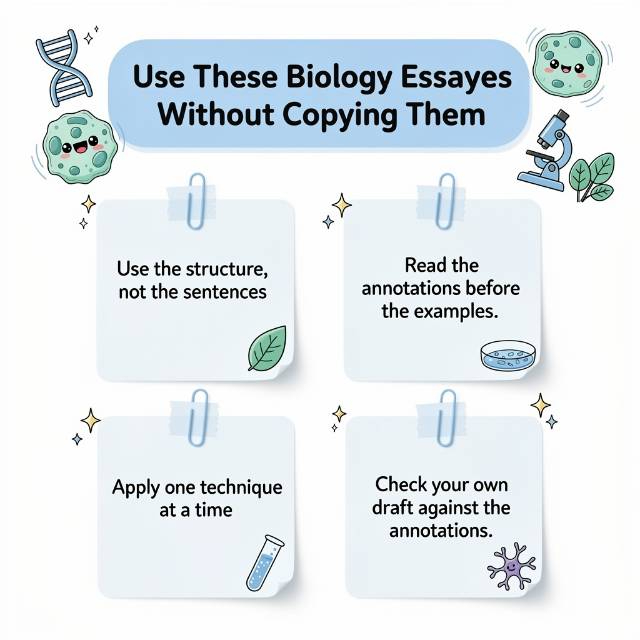
- Use the structure, not the sentences. Look at how the argumentative example opens with a problem, names a cause, and states a position. That's the template. The topic (neonicotinoids, colony collapse) is replaceable, but the logic isn't.
- Read the annotations before the examples. If you read the annotation first, you'll know what to look for when you read the example. You're training your eye to recognize good writing, not just reading it.
- Apply one technique at a time. If your intro is weak, focus on the intro comparison section. Work on that one thing before moving to the body paragraph.
- Check your own draft against the annotations. After you write, ask: Does my thesis take a real position? Does my topic sentence anchor the paragraph? Is my evidence connected to my argument, or just cited and dropped?
The goal isn't to copy what worked; it's to understand why it worked, then do it yourself.
Not sure what to write about yet? We've put together a list of biology essay topics worth exploring. |