If you've been assigned a biology essay and you're not sure where to start, you're not alone. Most students already know how to write an essay but a biology essay feels different. That's because it is. A biology essay is a written piece where you analyze, argue, or explain a biological concept, process, or issue using scientific evidence and the structure, sources, and expectations are specific to the discipline. Students who need handson biology essay help often find that the discipline specific rules are exactly what trips them up.
The biggest mistake students make with biology essays is treating them like any other essay; biology has its own rules.
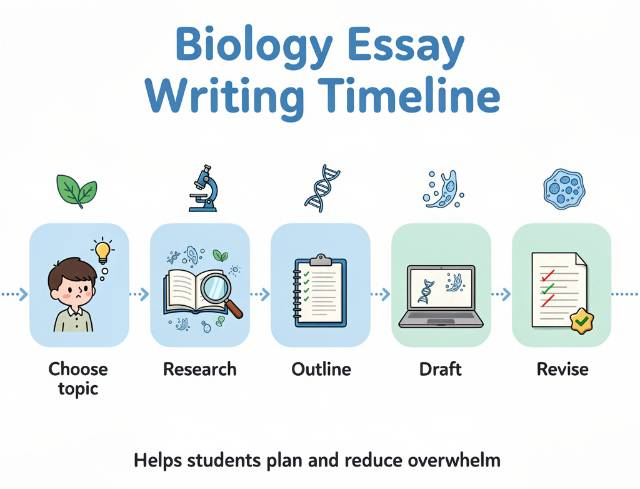
How to Write a Biology Essay: Quick Overview
- Identify your essay type (analytical vs. scientific/lab style)
- Choose a narrow, researchable topic
- Build your outline (intro = body paragraphs = conclusion)
- Write your introduction with a strong thesis
- Write evidence backed body paragraphs (one idea per paragraph)
- Write your conclusion without introducing new information
- Format citations correctly (APA, CSE, or MLA)
What Is a Biology Essay?
A biology essay is a written academic piece where you make and support an argument or explain a process or concept using biological knowledge and peer reviewed scientific evidence. It's not a lab report (unless it is), and it's not a general science summary. It's a focused, structured piece of writing built around a specific biological question or claim.
Here's the thing most guides skip over: not all biology essays are the same type. Knowing which one you're writing changes your entire approach.
The Two Main Types of Biology
Type | When You'll Write It | Key Structure | Citation Style |
Analytical/argumentative (humanities style) | Environmental science, bioethics, and ecology courses | Intro = thesis = body = conclusion | APA or MLA |
Scientific/lab style | Upper level biology, AP Bio, university lab courses | Abstract = methods = results = discussion | CSE |
The analytical essay is the most common for general biology courses. You take a position on a biological issue and defend it with evidence. The scientific essay mirrors a research paper; it's more structured and data driven.
If you're not sure which one your professor wants, check the assignment sheet. The structure and expectations are different enough that mixing them up can cost you real marks.
How to Choose a Biology Essay Topic
A good biology essay topic is specific. "Climate change" is not a topic; it's a category. "The effect of rising ocean temperatures on coral reef bleaching rates in the Great Barrier Reef" is a topic.
"A good biology essay topic is specific and researchable. Before committing, check Google Scholar or PubMed to confirm peer reviewed sources exist."
If you're still deciding, check out our full list of biology essay topics organized by difficulty and essay type. |
Biology Essay Outline: The Structure You Need
Most biology essays the analytical, argumentative kind, follow a clear structure. Here's what each part does and what biology specific requirements apply.
Biology Essay Introduction
(Aim for 10% of your total word count, roughly 100 words in a 1,000-word essay)
How to write a biology essay introduction? It has three jobs: hook the reader, give them enough context to understand what you're arguing, and end with a clear thesis statement.
For the hook in a biology essay, your strongest options are:
- A striking statistic from a peer reviewed study or authoritative source
- A real world phenomenon that illustrates the biological problem
- A question your essay will answer (use sparingly it can feel gimmicky if done poorly)
Avoid restating the assignment prompt. Avoid being vague. And don't bury your thesis it belongs at the end of the introduction, not the end of the body section.
The most common intro mistake is a weak thesis. Here's the difference: Weak: "Antibiotic resistance is a growing problem." This is a fact, not an argument. Any reader already knows it's a problem. You haven't told them what you're arguing. Strong: "The overuse of antibiotics in livestock farming is the primary driver of antibiotic resistant superbugs, and regulatory intervention at the agricultural level is the only solution with meaningful scale." This is a thesis. It makes a specific, arguable claim. You can now build a whole essay defending it. |
Your thesis should tell the reader exactly what you're arguing and ideally why it matters. If you can't argue against your own thesis, it's probably not strong enough.
Follow the hook with one or two sentences of background context enough to orient the reader, not a full literature review. Then end with your thesis. |
Biology Essay Body Paragraphs
(This section carries 75–80% of your word count. Each paragraph should be 150–200 words.)
Each body paragraph covers one idea. The structure is simple: make a claim, back it with evidence from peer reviewed sources, explain what that evidence means, and connect it back to your thesis.
For a standard biology essay, you'll typically write three to five body paragraphs. If your essay involves data, diagrams, or figures, reference them within the relevant paragraph, number them (Figure 1, Table 1), and cite the original source.
Here's what a strong body paragraph looks like:
Antibiotic resistance is accelerating partly due to overuse in agricultural settings. A 2019 study published in Science found that approximately 73% of all antimicrobials sold globally were used in food-producing animals (Van Boeckel et al., 2019). When animals are routinely exposed to sub-therapeutic antibiotic doses, bacteria develop resistance through natural selection and those resistant strains can transfer to humans through the food supply. This makes livestock antibiotic use one of the most urgent drivers of the resistance crisis.
That's the structure: topic sentence = evidence (with citation) = explanation = so what. Keep every body paragraph tight.
Biology Essay Conclusion
(Keep to 10%: no new information, just synthesis and significance)
Your conclusion restates your thesis in different words, not a copy paste summarizes the key points you've made, and ends with significance. Why does this topic matter in the bigger picture of biology, public health, or the environment?
Don't introduce new information in the conclusion. Don't end with "In conclusion." Just drive the point home and close cleanly. |
Example Outline: Antibiotic Resistance and Livestock Farming
Thesis: Overuse of antibiotics in food-producing animals is the primary driver of antibiotic-resistant superbugs, and regulatory intervention at the agricultural level is the only scalable solution.
- Body Para 1: Scale of antibiotic use in livestock, 73% of global antimicrobials used in food-producing animals
- Body Para 2: Mechanism, sub therapeutic doses create selection pressure, driving resistance
- Body Para 3: Transmission, resistant strains transfer to humans through the food supply
- Conclusion: Why farm level regulation is the only intervention with meaningful scale
?
Need Help With Your Biology Essay?
Get expert support to write clear and well-structured biology essays
Biology Essay Format and Citation Guide
Format requirements vary by professor, so always check the assignment guidelines first. The typical defaults are: 12-point font (Times New Roman or Arial), double spaced, one-inch margins. Nothing unusual here.
What varies and where students often get tripped up is citation style.
Citation Style | When It's Used | Example Format |
APA | Social/environmental biology, psychology of biology, most college courses | Van Boeckel, T. P., et al. (2019). Science, 365(6459). |
CSE (Council of Science Editors) | Natural sciences, upper level biology, research heavy courses | Van Boeckel TP, et al. 2019. Science. 365(6459):eaaw1944. |
MLA | Interdisciplinary or humanities adjacent biology courses | Van Boeckel, Thomas P., et al. "Global Trends." Science, vol. 365, 2019. |
If your assignment sheet doesn't specify a style, default to APA for college level biology.
On diagrams and figures: If you include them, they need a number (Figure 1, Table 2), a caption describing what they show, and a citation for the original source. An uncited figure in a biology essay is the same as an uncited quote it's a credibility problem.
Intext citations appear in the body of your essay wherever you reference a source. The reference list (or bibliography) appears at the end, listing full source details for everything you cited.
Tips for Writing a Good Biology Essay
These aren't generic essay tips. These are the things that specifically matter in a biology context.
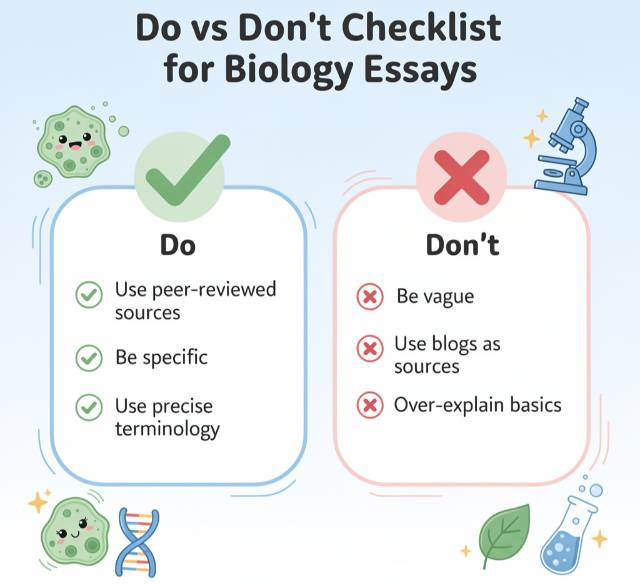
- Use peer-reviewed sources only. Google Scholar, PubMed, and JSTOR are your go-to databases. Wikipedia is fine for background orientation, but it's not a citable source for an academic essay. Your professor knows the difference.
- Be specific with your evidence. "Studies show that antibiotic resistance is rising" is weak. Cite the actual study. Name the finding. Give the number. Specificity is what separates a strong biology essay from a vague one.
- Don't over-explain basic biology. You're writing for your professor, not for a general audience. They know what mitosis is. Focus your explanation on your argument, not on teaching foundational concepts they already know.
- Use precise scientific language, but keep it readable. Jargon without explanation loses marks. If you use a specialized term, define it once and then use it confidently throughout. Don't avoid technical language; biology has a precise vocabulary for a reason.
- Proofread for scientific accuracy, not just grammar. Getting a word wrong in biology, confusing "mitosis" and "meiosis," for example, signals a fundamental misunderstanding. Read back through specifically for terminology precision.
- Write your thesis last. This sounds backwards, but it works. Write the body paragraphs first to figure out what you're actually arguing. Then write the introduction and thesis once you know exactly where the essay landed.
Common Biology Essay Mistakes to Avoid
- Writing about biology generally, instead of arguing a specific point
- Using non-peer-reviewed sources (blogs, encyclopedias, general websites)
- Forgetting to number, caption, and cite diagrams or figures
- Confusing the essay type, writing an analytical essay when a scientific report was expected, or vice versa
- A thesis that states a fact instead of making an arguable claim
- Copying the structure of a general English essay into a science context without adjusting for biology's expectations
Looking for real world examples to compare against? Browse our biology essay examples to see what strong and weak essays look like side by side. |
Wrapping Up
Biology essays are manageable once you know which type you're writing and what each part of the structure is actually supposed to do. The students who struggle most are the ones who treat it like a standard English essay, same template, different topic. It doesn't work that way.
The things that matter most: know your essay type before you start, pick a specific and researchable topic, build your argument around peer-reviewed evidence, cite everything correctly, and proofread for scientific accuracy as well as grammar.
Sometimes, though, even with the right guidance, you're up against a deadline that doesn't leave enough time to do it properly. Or the topic is genuinely complex, and you need it done to a standard your current knowledge can't quite reach. That's exactly what CollegeEssay is there for.
Write High Quality Biology Essays
Learn how to present scientific ideas clearly and effectively
- Help with research and topic selection
- Scientific writing guidance
- Clear and logical structure
- Professional editing support