Political Science Essay Topics: 250 Ideas for College Students by Subfield and Difficulty
Political science essay topics need three constraints before they become workable: a location, a time period, and a causal mechanism. 'Globalization and democracy' is a subject. 'Did social media accelerate political polarization in the US more than cable news did between 2008 and 2020' is a topic you can actually finish. Below are 250+ topics already built that way pick one or use the formula to adapt any subject you already have.
Political Science Essay Topics by Difficulty Level
Matching your political science essay topic to your year and word count matters more than picking the most interesting topic because a well-scoped argument at the right level beats a fascinating one you cannot finish.
Beginner: Best for First-Year Students or Short Assignments (500 to 1,000 words)
- Should the U.S. lower the federal voting age to 16?
- Should political advertising on social media be banned in the 30 days before an election?
- Should jury duty be replaced with a professional jury system?
- Should the U.S. president be limited to one six-year term instead of two four-year terms?
- Should all public universities in the U.S. be tuition-free?
- Should the U.S. Constitution require a balanced federal budget?
- Should political parties be publicly funded and private donations banned?
Intermediate: Best for Sophomore/Junior Level (1,200–2,500 words)
- Did the Arab Spring (2010–2012) produce lasting democratic change or accelerate authoritarianism?
- Has NATO expansion since 1999 increased or decreased European security?
- Did the UK's Brexit referendum reveal a failure of deliberative democracy?
- Did South Korea's democratic consolidation (post-1987) outperform Taiwan's on institutional stability?
- Has social media accelerated political polarization in the U.S. more than cable news did in the 1990s?
- Did the EU's handling of the Greek debt crisis (2010–2015) prioritize creditor interests over democratic sovereignty?
- Has China's social credit system produced measurable governance improvements or mass rights violations?
Advanced: Best for Senior/Graduate Level or Long Papers (2,500+ words)
- Did Gramsci's concept of hegemony better explain Trump's 2016 coalition than Laclau's populism theory?
- Has the rise of sovereign wealth funds (post-2005) shifted state power back toward governments in liberal economies?
- Did the post-Cold War liberal international order fail because of its internal contradictions or because of great-power revisionism?
- Does Acemoglu and Robinson's institutions thesis (Why Nations Fail, 2012) hold up against China's authoritarian growth since 2001?
- Did the Responsibility to Protect doctrine (R2P, 2005) survive Syria and Libya as a functional norm or become a dead letter?
- Has judicial review in emerging democracies (post-1990 Eastern Europe) served as a democratic safeguard or elite veto?
- Did the Washington Consensus (1989–2000s) produce convergence or divergence in Latin American development outcomes?
Already covered both formats and still uncommitted? If you've read all 40 and the problem isn't options but commitment, you can argue three of them but can't tell which one will actually hold up across 1,500 words, tell us your subfield, your word count, and the position you'd lean toward, and our essay writing service across academic subjects can either help you lock the topic or write the essay around it from start to finish.
Political Argumentative: 20 Ideas With Two Defensible Sides
These work because they have two genuinely defensible sides. Pick one only if you can argue the opposing position too; argumentative essays fall apart when the writer has already decided one side is obviously right.
- Should the UN Security Council have authority to override sovereignty in cases like Syria (2011–present) or Myanmar (post-2021)?
- Has India's experiment with parliamentary democracy since 1947 outperformed comparable presidential systems on stability metrics?
- Did Germany's NetzDG law (2017) reduce online hate speech without unduly restricting political speech?
- Did the U.S. CHIPS and Science Act (2022) constitute legitimate industrial policy or distortive state intervention?
- Should the U.S. abolish the Electoral College in light of the 2000 and 2016 popular-vote/electoral split?
- Was the U.S.-led democratization push in Iraq (2003–2011) ever ethically defensible given its outcomes?
- Should U.S. presidential candidates be legally required to disclose tax returns, given the post-2016 norm collapse?
- Have campus speech codes at U.S. universities (2014–2024) protected discourse or chilled it?
- Did the UK's NHS founding model (1948) outperform the U.S. ACA (2010) as a framework for universal coverage?
- Should the Second Amendment be reinterpreted in light of the Heller (2008) and Bruen (2022) Supreme Court rulings?
- Has Australia's compulsory voting (since 1924) produced more representative outcomes than voluntary-voting democracies?
- Did the U.S. Supreme Court's Dobbs decision (2022) constitute legitimate judicial review or judicial overreach?
- Would Germany's public party-funding model produce cleaner U.S. elections if adopted?
- Did sanctions on Russia (2022–present) achieve foreign policy goals or harm civilians more than the regime?
- Should sitting U.S. presidents be indictable, given the precedent debate from Nixon to Trump?
- Has the U.S. two-party system produced more polarization than Germany's multi-party system since 2000?
- Should U.S. Supreme Court justices face a mandatory retirement age, as judges do in Canada (75) and the UK (70)?
- Did President Biden's clemency for federal marijuana possession (2022) align with or contradict equal justice principles?
- Did France's 2004 secularism law restrict religious expression more than Germany's parallel approach?
- Was "national interest" a coherent justification for the U.S. withdrawal from Afghanistan in 2021?
Political Science Persuasive Essay Topics: 20 Ideas Where You Argue One Side
Persuasive essays let you take a clear side from sentence one. Choose these when your professor wants conviction, not just balance.
- The U.S. should adopt single-payer healthcare modeled on Taiwan's NHI (operational since 1995).
- U.S. federal judges should be required to disclose stock holdings, following the 2021 WSJ reporting on judicial conflicts.
- The U.S. Inflation Reduction Act (2022) should be expanded to phase out fossil-fuel subsidies entirely by 2030.
- The Electoral College should be replaced via the National Popular Vote Interstate Compact, not a constitutional amendment.
- Voter ID laws passed in Georgia and Texas (2021) should be repealed based on disenfranchisement evidence.
- The U.S. should redirect 10% of its annual defense budget to K–12 education, modeled on shifts in post-Cold War Germany.
- The federal minimum wage should be indexed to MIT's Living Wage Calculator by metro area, not set as a flat number.
- The U.S. should adopt Canada's Express Entry skilled-immigration model with structured pathways for undocumented workers.
- Section 230 should be reformed so that platforms above 100 million users face common-carrier obligations.
- The U.S. should expand sanctions architecture against authoritarian regimes using the Magnitsky Act framework.
- Congressional term limits, six terms in the House, two terms in the Senate, should be enacted by constitutional amendment.
- Former federal officials should face a ten-year lobbying ban, exceeding the current two-year cooling-off period.
- Ranked-choice voting, as used in Maine since 2018, should replace plurality voting in all federal elections.
- The U.S. Supreme Court should be expanded to thirteen justices with 18-year staggered terms.
- All U.S. states should require a year of civics instruction for high school graduation, modeled on Florida's 2010 mandate.
- Political ads on platforms above 50 million users should be subject to FTC truth-in-advertising rules.
- The 1973 War Powers Resolution should be amended to require congressional approval within 30 days, not 60.
- Public funding should fully replace private funding in U.S. presidential primaries, modeled on Germany's matching-fund system.
- Election Day in the U.S. should be a federal holiday, as it is in 27 OECD countries.
- Washington, D.C. should be granted statehood through the Washington, D.C. Admission Act.
International Relations and Diplomacy Essay Topics
International relations and diplomacy topics work best when anchored to a specific bilateral relationship, treaty or intervention rather than broad concepts like globalization or multilateralism because the evidence base is more contained and the argument is easier to bound.
- Has globalization since 1995 (WTO founding) accelerated cooperation or sharpened conflict in the U.S.-China relationship?
- Comparing the foreign policy doctrines of Bush (2001), Obama (2009), and Biden (2021), continuity or rupture?
- Did the Camp David Accords (1978) succeed where the Oslo Accords (1993) failed, and why?
- Did Russia's 2022 invasion of Ukraine disprove the economic-interdependence-as-deterrent thesis?
- Did the Rome Statute (1998) make international criminal law more enforceable, or less, in the past 25 years?
- UN peacekeeping in Rwanda (1994) vs. Sierra Leone (1999), what explains the divergent outcomes?
- Did China's Belt and Road Initiative (2013–present) outperform U.S. soft-power efforts in Africa?
- Has Hungarian-style nationalism (post-2010) reshaped EU multilateralism more than Brexit did?
- How did the U.S. cyber response to the 2016 election interference reshape doctrine through 2024?
- Has nuclear deterrence held in the India-Pakistan dyad since 1998 because of the doctrine, or in spite of it?
- Has Turkey's foreign policy under Erdo?an (2003–present) made it a regional power or an isolated one?
- Did the Paris Agreement (2015) reframe climate change as a security policy, or did it remain environmental policy?
- What does NATO's response to Russia's 2022 invasion of Ukraine reveal about the alliance's post-2030 trajectory?
- Did sanctions on Iran (2012–2015) succeed in bringing it to the JCPOA negotiating table, or coincide with it?
- Did Hezbollah's 2006 conflict with Israel mark the rise of non-state actors as peer adversaries to states?
- How did Norwegian Track-II diplomacy enable the Oslo Accords (1993), where official channels had failed?
- Did the CIA's role in the 1953 Iran coup or the 1973 Chile coup do more long-term damage to U.S. foreign policy?
- Does U.S. foreign aid conditionality (post-1990 Cold War end) function as soft power or coercion?
- The collapse of the INF Treaty (2019) and New START's expiration, what does it reveal about arms control's future?
- China's Great Firewall (2003–present) and Russia's Runet (2019), competing models of cyber sovereignty?
Comparative Politics Essay Topics
Comparative politics topics are strongest when they name two clearly defined cases and one mechanism to compare them. A topic like "why did democratization succeed in Spain but stall in Egypt" is more arguable than "comparing democratic transitions" because the cases are set and the question is already formed.
- Comparing electoral systems: Germany's MMP, the UK's FPTP, and New Zealand's MMP transition (1996).
- Why did India's Congress Party decline (1989–2014) while Botswana's BDP retained dominance?
- Turkey's AKP-era secularism vs. Indonesia's Pancasila, two Muslim-majority approaches to religion in politics.
- Why did democratization succeed in Spain (post-1975) but stall in Egypt (post-2011)?
- Comparing the Nordic, German, and U.S. welfare models on poverty reduction since 2000.
- Did civil society in Tunisia (2011) succeed in democratization where Egypt's failed because of organizational density?
- Did Spain's 1978 devolution to autonomous communities prevent or delay the Catalan independence crisis?
- Why did East Germany's transition outperform Russia's in the 1990s despite similar starting conditions?
- Brazil's presidential gridlock under Bolsonaro vs. Germany's parliamentary stability under Merkel, what explains the gap?
- Did globalization in the 2000s strengthen East Asian developmental states while weakening European welfare states?
- Why has Saudi Arabia's monarchy survived since 1932 while Iran's collapsed in 1979?
- Why has the Pakistani military intervened in politics repeatedly since 1958, while the Indian military has not?
- Comparing the rise of Trump (2016), Modi (2014), and Bolsonaro (2018), populism as a comparative phenomenon.
- Why are Scandinavian elections trusted while U.S. election trust collapsed post-2020?
- Did South Africa's 1996 constitutional design help or hinder its post-apartheid stability?
- Coalition formation in Italy (post-2018), Germany (2021 traffic-light), and Israel (2021 anti-Bibi), what explains durability?
- Hungary under Orbán (2010–present), when does competitive authoritarianism stop being democracy?
- Why did devolution defuse separatism in Scotland but inflame it in Catalonia?
- The Brazilian Supreme Court (2018–2022) and South Africa's Constitutional Court (post-1994), courts as democratic guardians.
- Compulsory voting in Australia (since 1924) vs. Belgium (since 1893) vs. Brazil (since 1932), outcomes compared.
CollegeEssay.org's writers find that intermediate-level comparative politics topics with two clearly defined cases and one decade and one mechanism produce the strongest first drafts from students writing under time pressure.
Political Theory and Political Philosophy Essay Topics
Political theory and philosophy topics require you to apply a named framework to a concrete case; the argument only works when you pair a theorist with a specific event or policy rather than asking whether a theory is "correct" in the abstract.
- Rawls's A Theory of Justice (1971) vs. Nozick's Anarchy, State, and Utopia (1974), has the debate been resolved?
- Lukes's three faces of power (1974) applied to U.S. campaign finance after Citizens United (2010).
- Did Polanyi's The Great Transformation (1944) anticipate the 2008 financial crisis better than Hayek's The Road to Serfdom (1944)?
- Was Martin Luther King's civil disobedience in Birmingham (1963) more philosophically defensible than the 2020 racial justice protests?
- Mill's harm principle (On Liberty, 1859) applied to vaccine mandates during COVID-19.
- Was the U.S. New Deal (1933–1939) Rawlsian, libertarian-resistible, or beyond both frameworks?
- Did the EU's response to the 2015 refugee crisis prove sovereignty is still the operating concept of international order?
- Aristotle's Politics on the middle class, does the thesis hold up against 21st-century U.S. middle-class decline?
- Plato's Republic on the philosopher-king vs. Machiavelli's The Prince on virtù, applied to modern democratic leadership.
- Did Carol Pateman's 1988 book better explain post-Roe U.S. politics than Rawlsian liberalism?
- Liberalism's response to its critics, has Rawls's Political Liberalism (1993) answered the communitarian critique?
- Was the 2017 Charlottesville rally a test case where the "public good" became fundamentally contested?
- Did Weber's three types of legitimacy (1922) accurately predict the rise of Putin's Russia after 2000?
- Pettit's republican non-domination (1997) applied to U.S. workplace law since NLRB v. Noel Canning (2014).
- Did Habermas's discourse theory (1981) survive the rise of social media as a public sphere after 2010?
- Hannah Arendt's Origins of Totalitarianism (1951) applied to the January 6, 2021, Capitol attack, fits or strains?
- Foucault's Discipline and Punish (1975) applied to U.S. mass incarceration since the 1994 Crime Bill.
- Sen's capabilities approach (1985) vs. GDP per capita as a measure for evaluating Bangladesh's development since 2000.
- Republican non-domination vs. liberal non-interference, which better explains U.S. labor law since Janus (2018)?
- Schmitt's friend-enemy distinction applied to U.S. partisan politics since 2016, diagnostic or self-fulfilling?
Public Policy and Administration Essay Topics
Public policy topics are most defensible when they compare the same policy across two jurisdictions or evaluate one policy against its stated goals using outcome data rather than intent.
- Did Costa Rica's payment-for-ecosystem-services program (1996–present) integrate environmental and economic policy successfully?
- Did Iceland's "Better Reykjavík" platform (2010–present) genuinely reshape policy decisions or perform participation?
- Why did India's GST rollout (2017) face implementation friction that Australia's GST (2000) avoided?
- UK NHS, U.S. ACA, German Bismarck, Canadian single-payer, outcomes on cost, access, and quality since 2010.
- Did the UK's PFI hospital program (1992–2018) deliver value or saddle the NHS with debt?
- Why did Germany's Energiewende (2010–present) succeed where Australia's carbon-pricing scheme (2012–2014) failed politically?
- Did NAFTA (1994–2020) constrain Mexico's labor policy autonomy more than the EU constrained Greece's after 2010?
- Did the UK's Investigatory Powers Act (2016) strike the right rights/safety balance, or fail both?
- Did the U.S. Department of Veterans Affairs scandal (2014) confirm or refute the "bureaucracy as self-perpetuating" thesis?
- Was the Cambridge Analytica case (2018) a failure of policy ethics, regulatory ethics, or both?
- Did Mexico's CONEVAL evidence-based poverty measurement (2004) improve policy outcomes more than the U.S. Census poverty measure?
- Why did California's high-speed rail program (authorized 2008) underdeliver while Spain's AVE network succeeded?
- Was the Chevron deference doctrine (1984–2024) democratically legitimate, and does its overturning improve or worsen governance?
- Did the UK's Behavioural Insights Team (2010–present) produce more public good than Sunstein-style federal nudges in the U.S.?
- Why have U.S. cities led on climate policy (post-2017) while the federal government lagged?
- How did frontline TSA agents reshape U.S. airport security policy in implementation (2002–present)?
- Why did LGBT+ marriages spread across U.S. states (2003–2015) faster than carbon-pricing policies have?
- Did the U.S. Patriot Act (2001) sunset clauses produce real review or rubber-stamp renewal?
- UBI pilots in Stockton (2019) and Finland (2017–2018), what's the evidence after the data is in?
- EU ETS vs. British Columbia carbon tax (2008–present) vs. RGGI in U.S. Northeast, design and outcomes compared.
American Politics and Government Essay Topics
American politics and government topics have the deepest peer-reviewed source base of any subfield on this page which makes them the safest choice for students who need five solid academic sources within a short research window.
- Did political polarization in the U.S. accelerate measurably between 2010 and 2024, and what's the evidence?
- Did the 2008 bank bailout reshape the U.S. federal government's role in the economy more than the New Deal did?
- Did the 2015 Obergefell ruling end the U.S. culture war on marriage, or shift it elsewhere?
- Did California's COVID-19 response vs. Florida's (2020–2022) reveal federalism's strengths or fractures?
- The NRA's influence on U.S. gun policy (1980–2024), case study in interest-group power.
- Did Fox News (post-1996) reshape American conservative opinion or simply reflect it?
- Wisconsin's 2011 voter ID law vs. Oregon's automatic voter registration (2016), turnout effects compared.
- Has the Electoral College systematically advantaged one party since 2000, or is it a structural coin flip?
- Money in the 2024 U.S. presidential election, what changed since Citizens United (2010)?
- Has the U.S. Constitution's design produced more stability than flexibility since 1787?
- Did the post-9/11 expansion of executive power survive the Obama and Trump presidencies, and at what cost to Congress?
- Has the Roberts Court (2005–present) been more political than the Rehnquist Court (1986–2005)?
- Did the 1965 Voting Rights Act's gutting in Shelby County v. Holder (2013) reverse 50 years of progress?
- Did the Rucho v. Common Cause (2019) ruling effectively legalize partisan gerrymandering?
- Why did Ross Perot's 1992 campaign fail despite 19% of the popular vote, and what does it cost American politics?
- Did the filibuster's transformation since 1975 (from rare to routine) make the Senate more democratic or less?
- Has presidential power expanded more under Trump's executive orders (2017–2021) or Biden's (2021–2025)?
- Did the 2016 Republican primary and the 2020 Democratic primary reveal that primaries cause polarization?
- Did Trump's Schedule F executive order (2020) and Biden's reversal reveal the politics of bureaucratic capture?
- Texas vs. cities on bathroom bills, immigration, and abortion, state preemption as the new federalism front.
Political Parties and Elections Essay Topics
Political parties and elections topics work best when focused on a single electoral cycle or a single institutional rule rather than party history broadly because the causal chain is shorter and the evidence is more recent and accessible.
- Did the 2010 Citizens United decision change the integrity of U.S. elections, or did it just make existing dynamics legal?
- Why did the Republican Party's 2016 establishment fail to stop Trump, where the Democratic establishment stopped Sanders?
- Did Cambridge Analytica's role in 2016 (U.S.) and the Brexit vote actually move outcomes, or just consume attention?
- North Carolina's 2013 voting law vs. Texas's SB1 (2021), comparing voter-suppression mechanisms and effects.
- AIPAC's influence on U.S.-Israel policy (2010–2024), interest-group case study.
- California's open primary (2012) vs. New York's closed primary, outcomes for moderate candidates.
- Did Trump's 2016 ad spend on Facebook outperform Clinton's traditional buy in measurable persuasion terms?
- The architecture of independent expenditure: tracking the top-five Super PACs in the 2024 cycle.
- Did Maryland's 2011 redistricting harm Democrats nationally more than Republican gerrymandering of North Carolina?
- Did Obama's 2008 charisma move votes the Clinton 2016 campaign couldn't, or did the electorates differ?
- Has independent voter identification grown more in the U.S. since 2000 than in any other OECD democracy?
- McCain-Feingold (2002), DISCLOSE Act attempts (2010–present), why does U.S. campaign finance reform keep failing?
- Did mail-in voting expansion in 2020 affect turnout, fraud rates, or just public perception of fraud?
- Have U.S. presidential debates since 2016 measurably moved voter preference, or only reinforced priors?
- Did Cambridge Analytica's microtargeting framework normalize what the Trump 2020 and Biden 2020 campaigns refined?
Political Ideologies Essay Topics
Political ideology topics require you to define the ideology precisely before making any argument about it. The most common failure is treating "neoliberalism" or "populism" as self-evident when the definition is itself contested and must be established in the opening paragraph.
- Comparing liberalism, conservatism, socialism, and fascism through their responses to the 2008 financial crisis.
- Did neoliberal ideology shape the IMF's 1990s structural adjustment programs more than national interests did?
- Did Hungarian Fideszism (post-2010) prove that some democratically elected ideologies corrode democracy from within?
- Did neoliberalism diffuse globally because of ideas (Hayek, Friedman) or because of institutions (IMF, World Bank)?
- Have third-wave feminism (1990s) or fourth-wave feminism (2010s) more reshaped policy outcomes?
- Did the Christian Right's mobilization (post-1979 Moral Majority) shape U.S. politics more than evangelical theology shaped the Christian Right?
- Has the Tea Party movement (2009) been better understood as racial backlash or fiscal ideology?
- Did Black Lives Matter (2013–present) shape U.S. progressive politics more than Occupy Wall Street (2011) did?
- Why did the Republican Party absorb Trumpism (2016–present) where the British Conservative Party expelled Corbyn-style positions?
- Did the Tarrant County (2019) and El Paso (2019) attacks reveal that political ideology now drives U.S. terrorism more than religion?
- Why does U.S. left-libertarianism (Chomsky tradition) have less political traction than right-libertarianism (Cato tradition)?
- Did the German Greens' 2021 coalition entry validate eco-socialism or co-opt it?
- Is Modi's BJP (2014–present) better understood as authoritarian populism, Hindu nationalism, or governing strategy?
- Is "neoliberalism" a coherent ideology, or a left-academic catch-all? Test the case using post-2008 policy responses.
- Does Silicon Valley's techno-utopianism (Andreessen, Thiel, Musk) constitute a coherent political ideology?
Human Rights and Justice Essay Topics
Human rights and justice topics are strongest when they compare enforcement mechanisms rather than rights claims themselves because the interesting question is never whether a right exists but whether any institution has the power and will to protect it.
- Did the ICC's 2023 Putin warrant strengthen international criminal law's enforceability or expose its limits?
- Did the post-1948 UDHR universalize human rights, or did 21st-century localization (China, Saudi Arabia) fragment them?
- Comparing China's, the EU's, and Brazil's responses to the UN Human Rights Council since 2010.
- Did the UN Human Rights Council outperform its predecessor (the Commission, 1946–2006), or replicate its weaknesses?
- Did Black Lives Matter mainstream a human-rights frame for U.S. racial justice that the civil rights movement avoided?
- Did Saudi Arabia's 2018 murder of Khashoggi prove human rights abuses can persist without diplomatic consequence?
- How did Memorial in Russia (founded 1989, dissolved 2022) shape human rights discourse, and what did its closure reveal?
- Did South Africa's TRC (1996) accomplish more than Rwanda's Gacaca courts (2001–2012), and at what cost?
- Did Ring doorbell cameras and Pegasus spyware (2016–present) outpace human-rights protections faster than any prior tech?
- Did the New York Times' Pulitzer-winning Uyghur reporting (2019–2022) shift U.S. policy or just public awareness?
- Did the Snowden revelations (2013) effectively end the right to privacy as a settled concept in U.S. constitutional law?
- Did Germany's 2015 refugee admission and Hungary's 2015 border closure represent EU values or expose their limits?
- Did Bolivia's 2009 plurinational constitution succeed where Canada's Indigenous self-government framework has stalled?
- Truth commissions (South Africa 1996), prosecutions (Rwanda ICTR), reparations (Germany post-WWII), which model worked best, where?
- Why did the EU abolish the death penalty as an accession requirement while Japan retains it as a stable democracy?
Gender and Politics Essay Topics
Gender and politics topics produce the strongest arguments when grounded in a specific policy outcome or electoral result rather than a broad claim about representation because measurable data is available and the argument can be evaluated against evidence.
- Did Rwanda's gender quota (since 2003) produce a substantively different policy than Norway's voluntary parity?
- Did the gender gap in the 2024 U.S. election widen because of abortion politics or longer-term trends?
- Why did the 2024 U.S. election narrow the Black-white gender gap among voters but widen the Latino gender gap?
- Did the FAMILY Act (proposed 2013–present) fail because of gendered assumptions or partisan blocking?
- Comparing women's representation in Rwanda's Parliament (61%), Sweden's (47%), and the U.S. Congress (28%).
- Did Twitter/X's 2016 design enable more gendered harassment of women candidates than Facebook did?
- Did wartime violence against women in Bosnia (1992–1995) and Tigray (2020–2022) follow the same political logic?
- Did Jacinda Ardern's leadership style (2017–2023) prove women lead differently, or did it prove she led differently?
- Has Argentina's 2017 gender parity law produced different outcomes than Brazil's voluntary 30% quota since 2009?
- Did #MeToo (2017–present) accomplish more political change than second-wave feminism's institutional advocacy did?
- Why did anti-LGBTQ+ legislation surge across U.S. states in 2023 even as public opinion remained majority-supportive?
- Comparing LGBTQ+ rights in post-2014 Russia, post-2020 Hungary, and post-2017 Taiwan as fault lines in regime type.
- Did the post-Dobbs U.S. and Latin America's "green wave" (2020–2022) move in opposite directions on reproductive rights?
- Did Sweden's individualized parental leave (2016) shift the politics of care work more than U.S. piecemeal state laws?
- Did Gamergate (2014) preview the political online-harassment playbook that targeted women candidates by 2020?
Environmental Politics Essay Topics
Environmental politics topics are most defensible when they compare two policy instruments in two countries across the same time period because the outcome variables are measurable and the comparison controls for at least some external factors.
- Has the Paris Agreement (2015) shifted state behavior on emissions, or just rhetoric?
- Did the IPCC's 1.5°C report (2018) shape EU climate policy more than UN climate negotiations did?
- Why did Costa Rica decarbonize its electricity grid by 2017 while comparable Latin American countries didn't?
- Did Germany's 2022 energy crisis reveal that environmental and economic policy are aligned or in tension?
- Did the Flint water crisis (2014) reframe environmental justice as racial justice in U.S. policy?
- Did the Sunrise Movement (2017) shape the Green New Deal more than Greenpeace shaped earlier climate policy?
- Did British Columbia's carbon tax (2008) outperform California's cap-and-trade (2013) on emissions and political durability?
- Did Greta Thunberg's 2018–2019 visibility shift media coverage of climate policy, or just media coverage of Greta Thunberg?
- Did the WTO's environmental jurisprudence (post-1995) constrain national environmental policy more than help it?
- Did the 2009 ClimateGate emails and the 2021 IPCC report shape U.S. public opinion in opposite directions?
Media and Politics Essay Topics
Media and politics topics work when the causal direction is specified from the start. You need to decide whether you are arguing that media shaped political behavior or that political behavior shaped media coverage because the two arguments require entirely different evidence.
- Did the rise of CNN (post-1980) shape U.S. political discourse more than the rise of Fox News (post-1996)?
- Did Twitter/X reshape the 2024 U.S. presidential primary more than cable news did?
- Comparing the BBC's, Norway's NRK's, and PBS's political coverage models, what makes public media politically resilient?
- Did Trump's 2016 earned media advantage ($2 billion-plus) prove media exposure beats ad spend?
- Did Sinclair Broadcast Group's 2018 must-run script prove media ownership shapes political content more than journalists do?
- Did the 2020 "Hunter Biden laptop" story reveal disinformation patterns that the 2016 Russian interference established?
- Why has Germany regulated political ads more aggressively than France since 2017, despite similar starting points?
- Did The Washington Post's Watergate coverage (1972–1974) set a higher bar for political accountability than ProPublica's reporting since 2008?
- Did the 2013 Bezos purchase of The Washington Post and Murdoch's hold on Fox produce different ownership effects on political diversity?
- Did Habermas's public-sphere theory (1962) survive the 2010s rise of platform-mediated political discourse?
War and Peace Essay Topics
War and peace topics are strongest when focused on a specific conflict and a specific outcome variable such as civilian casualties, negotiation success or post-conflict stability rather than the causes of war broadly.
- Did the war in Ukraine (2022–present) confirm the post-1945 great-power-peace thesis or refute it?
- Did the Colombia-FARC peace process (2016) outperform the Israel-Palestine Oslo Accords (1993), and why?
- Did the ICRC's wartime work in Syria (2011–present) prove international humanitarian law still constrains conduct, or just documents it?
- UN peacekeeping in Mali (2013–2023), record and lessons compared to MONUSCO in Congo.
- Did Ukraine's drone warfare (2022–present) make autonomous weapons regulation more urgent or more impossible?
- Liberia's post-2003 peacebuilding vs. South Sudan's post-2011 peacebuilding: What explains divergent outcomes?
- Did the 1995 Dayton Accords end the Bosnian war by diplomacy, or by NATO's 1995 air campaign?
- Did the EU's economic interdependence model fail to deter Russia in 2022 despite working between France and Germany since 1957?
- Did embedded reporting in Iraq (2003) and citizen video from Ukraine (2022) reshape public perception of war differently?
- Did the Darfur conflict (2003–present) and Syria (2011–present) prove that environmental drivers (drought, water scarcity) intensify civil war?
Political Economy Essay Topics
Political economy topics require you to decide upfront whether you are making a claim about how institutions shape markets or how markets shape institutions because the two arguments pull in opposite directions and cannot be merged without losing the thesis.
- Did China's WTO accession (2001–2015) reshape U.S. manufacturing wages more than NAFTA did?
- Did Singapore's developmental state (1965–present) outperform South Korea's chaebol model on broad-based growth?
- Has Vietnam's market socialism (since 1986) outperformed pure capitalist transitions in comparable economies?
- Did the Green New Deal proposal (2019) accept that growth and sustainability are incompatible or aligned?
- Did Estonia's e-government model (2000–present) drive more economic development than its GDP-per-capita-similar peers?
- Did Apple's Irish tax structure (pre-2015 Apple/EU ruling) prove that multinationals govern fiscal policy more than states do?
- Did Pinochet's Chile (1973–1990) and Park's South Korea (1961–1979) demonstrate authoritarian capitalism's growth advantage, or just survivorship bias?
- Did the 2008 financial crisis prove that finance now governs the global economy, or expose how it always did?
- Did the 2017 NAFTA renegotiation (USMCA) confirm that trade liberalization needs labor and environmental standards to be politically sustainable?
- Did the IMF's 1997 Asian crisis response and 2010 Greek bailout reveal the same governance failure or different ones?
Regional Politics Essay Topics
Regional politics topics are strongest when focused on a specific regional organization and a specific mandate rather than "regional integration" broadly because the gap between stated goals and actual outcomes is where the argument lives.
- Did Brexit (2016–2020) accelerate or interrupt the EU's response to right-wing populism in Hungary and Poland?
- Did the African Union's 2002 founding produce more continental integration than the OAU achieved in 39 years?
- Did ECOWAS's 2017 Gambia intervention prove regional security architecture works in West Africa?
- Did ASEAN's 2015 Economic Community deliver real economic integration, or remain a declaratory framework?
- Why has SAARC's regional cooperation stalled since 2014, while ASEAN's has progressed?
- Did the BRICS 2024 expansion (UAE, Iran, Egypt, Ethiopia) increase its global governance weight or dilute its coherence?
- Did China's South China Sea construction (2013–2016) reshape regional security architecture more than the U.S. pivot to Asia did?
- Has CARICOM achieved more on climate diplomacy at COP since 2015 than on its founding integration mandate?
- Did the 2017 Qatar diplomatic crisis expose GCC fragility that the 2021 reconciliation failed to repair?
- Did regional organizations' COVID-19 responses (ASEAN, EU, AU) reveal capacities or expose them as theater?
You've got the topic. The harder part starts now: framing a thesis you can actually defend, finding sources that hold up, and writing 1,500–3,000 words of argument that doesn't fall apart under scrutiny.
If you'd rather hand the writing to people who do this every week, the CollegeEssay.org political science team turns your topic and instructions into a complete, sourced essay, usually within 24 hours, formatted to whatever style your professor requires.
How to Choose a Political Science Essay Topic in Under Ten Minutes
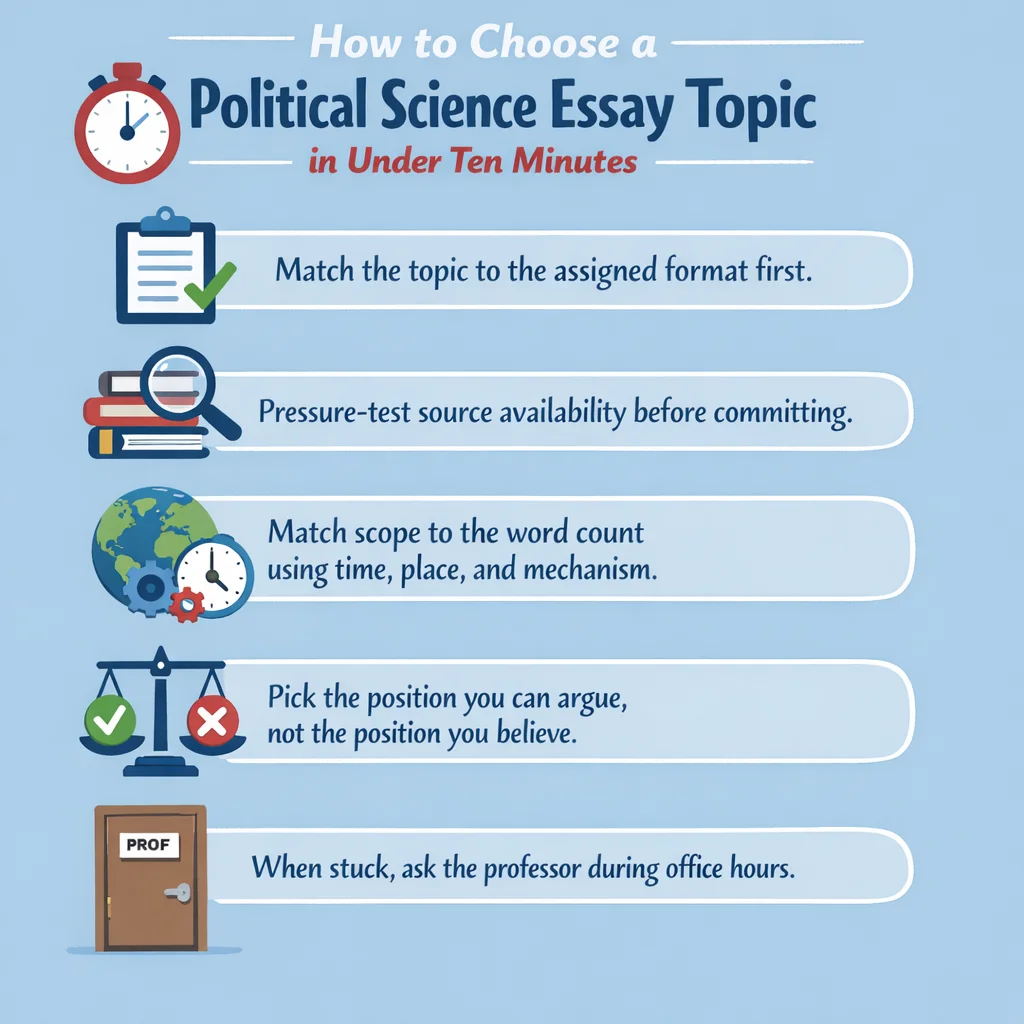
Choosing a political science essay topic in under ten minutes comes down to five checks: format match, source availability, scope calibration, argument strength, and professor alignment."
- 1 Match the topic to the assigned format first. An argument needs two defensible sides. Persuasive needs a clear position. Comparative needs at least two cases. If the topic doesn't fit the format, you'll fight the structure for the entire draft. CollegeEssay.org's political science topic library is organized by subfield and word count, useful as a cross-check once you've narrowed your topic, to confirm it has enough source depth to survive the bibliography stage without pivoting mid-draft.
- 2 Pressure-test source availability before committing. Search Google Scholar for two to three peer-reviewed pieces. If you can't find five solid sources within ten minutes, the topic will burn you in the bibliography stage. Move on.
- 3 Match scope to the word count using time, place, and mechanism. Narrow the scope to one country, one decade and one mechanism before committing. "Globalization and IR" is a dissertation. "How NAFTA reshaped Mexico's manufacturing labor market between 1994 and 2008" is a 2500-word essay. Every topic on this page already has this discipline applied.
- 4 Pick the position you can argue, not the position you believe. In an argumentative essay, your job is to construct the strongest argument, not to express a personal opinion. If you can argue both sides, pick whichever has the stronger evidence base.
- 5 When stuck, ask the professor during office hours. Five minutes with the professor saves five hours of writing the wrong thing. They'll tell you whether the topic is too broad, too narrow, or already over-assigned.
How to Get Your Political Science Essay Written Quickly?
You came here for a topic. You're leaving with one, plus a clearer view of which subfield you can actually defend. The next step is the writing itself, and that's where most students lose the weekend.
If you have a topic but not the time to write the essay, CollegeEssay.org's political science writers can deliver a researched, sourced, formatted essay within 24 hours. Send us your topic, word count, deadline, citation style, and get a complete political science essay within your deadline.
Frequently Asked Questions
- One time period instead of modern history
- One country or region instead of the world
- One mechanism such as a law, policy or institution instead of a broad relationship.

Get expert writing help.
- Expert writers in your subject
- 100% human-written work
- From $11 per page
Price shown before checkout.
We'll write the essay around it.
Topic, word count, deadline, citation style — complete sourced essay back in 24 hours.
See how it works

- By Difficulty Level
- Argumentative
- Persuasive
- International Relations
- Comparative Politics
- Political Theory
- Public Policy
- American Politics
- Parties & Elections
- Political Ideologies
- Human Rights
- Gender & Politics
- Environmental Politics
- Media & Politics
- War & Peace
- Political Economy
- Regional Politics
- How to Choose
- FAQ