Short Medical School Essay Example
A short-form medical school essay succeeds when every sentence is doing two jobs simultaneously: advancing the narrative and revealing character. The format is not a limitation when the underlying insight is precise enough that it does not need expansion.
Illustrative example. Demonstrates a short-form essay of approximately 250 words, relevant for secondary prompts with strict word limits and for applicants refining a tight primary statement.
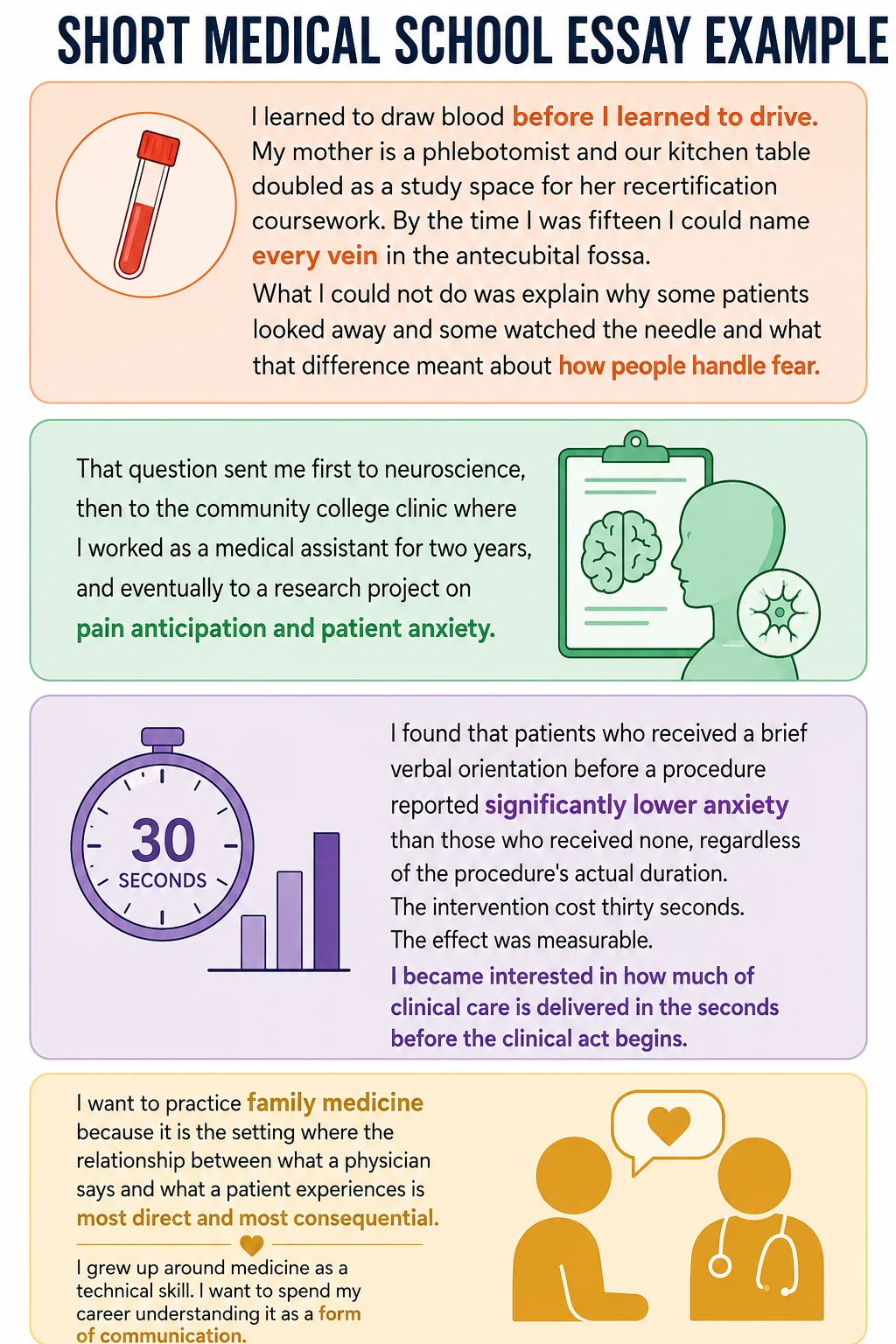
The opening establishes an unusual background in one sentence, grounds it in a specific domestic image in the second, and pivots to the clinical question the writer actually cares about in the fourth. Nothing is restated.
The short format earns its compression because the writer is not summarizing a journey but identifying a single question that medicine is the right discipline to answer. The full essay is available in the downloadable PDF.
Medical School Personal Statement Examples (Annotated)
A personal statement that works opens on a specific scene, follows one narrative thread, and ends with a precise claim about what the applicant understands medicine to require. CollegeEssay.org offers a dedicated medical school essay writing service staffed by writers who specialize in AMCAS applications.
The three examples below each demonstrate a different background and a different narrative approach. Excerpts are shown here; the full essays are available for download.
Example 1The Research-to-Patient Pivot
Illustrative example. Represents a science or engineering background with late clinical exposure.
The opening puts the reader in a specific place at a specific moment. The contrast between the failed lab task and the woman in the corridor sets up the essay’s central tension without stating it. The pivot from technical work to human presence is the narrative engine.
Reading a strong opening is easier than writing one. If you have material from your own experience and are not yet sure how to shape it into an opening that works the way these do, our subject-specific essay writing help can build the arc with you from where your draft currently stands.
Example 2The Community-Rooted Pathway
Illustrative example. Represents a first-generation applicant or community health background.
The scene is specific down to the detail of looking up a word, which makes the experience credible and anchors the abstract concept of language as a health barrier in something real.
The essay avoids framing the grandmother’s illness as the reason for pursuing medicine, which would read as sentimental. Instead it uses the moment to establish what the writer came to understand about medical encounters.
Example 3The Career-Change Frame
Illustrative example. Represents a career changer from a non-clinical profession.
The engineering metaphor works because it is specific to the writer’s actual background, not a borrowed analogy.
The opening establishes a professional identity before beginning to dismantle it, which is the correct order for a career-change essay. The reader understands who the writer was before understanding why they are changing.
Why Medicine Essay Examples and What Makes Them Work
Strong why medicine essays are built around a moment of reframed understanding rather than a description of clinical exposure from the outside.
Example 1Reframed Understanding
Opening excerpt
The essay opens on a prior belief and then shows it being overturned by a specific observed moment. This structure answers the “why medicine” question without ever stating it directly.
The writing demonstrates the pivot that distinguishes medicine from other helping professions: the job is sometimes to stay present rather than to resolve.
Example 2Personal Health Experience
The observation that outcomes correlated with type of question rather than time spent shows clinical awareness. The essay avoids the common trap of centering the personal illness as the motivation, instead using it to demonstrate something the writer learned about how the job works.
Why This Medical School Essay Examples
A strong why this school response would be false if you swapped in a different school name. A generic version names the school’s prestige and mentions a program from the homepage.
A specific version names a faculty member’s research, a clinical program that connects directly to the applicant’s background, or a patient population that aligns with the applicant’s stated interest.
1Why This School: What Not to Write
Illustrative example of a weak response.
This is true of most top-25 programs. Remove the school name and the paragraph still works, which means it fails.
2Why This School: What a Strong Response Looks Like
Illustrative example of a strong response.
Opening excerpt
Every sentence in a strong why-this-school response would be false if you swapped the school name. That is the test. The response connects a specific faculty member to the applicant’s specific background, names a specific program, and ends with a claim grounded in the applicant’s own experience rather than the school’s reputation.
Medical School Essay Examples by Target School
Harvard, Hopkins, and Stanford each have a distinct admissions culture that shapes the essays accepted applicants tend to write. Three PDFs below collect illustrative annotated examples for each school, built from publicly available patterns across accepted-applicant essays and advising resources.
Harvard accepted essays tend to trace a patient encounter or clinical experience to a systemic question, a research direction, or an ethical tension it raised. Essays that stop at the encounter level without analyzing what it revealed rarely succeed at HMS.
Hopkins accepted essays frequently address patient populations that are underserved or underrepresented in clinical research. The school’s urban health emphasis rewards essays that demonstrate structural awareness, not just clinical empathy.
Stanford accepted essays often connect the applicant’s background to a direction in medicine that does not yet fully exist. The essay is not just about what the applicant has done but about the specific contribution they intend to make.
For a closer look at how individual programs differ in research focus and clinical emphasis, the top nursing schools in the US guide breaks down the landscape by program type and specialty strength.
You now know what school-specific framing looks like for Harvard, Hopkins, and Stanford. The harder step is identifying which of your experiences connects specifically to a given school’s research agenda or clinical culture, and making that case in a secondary response of 150 words or fewer. Our professional essay writing services for your subject work with applicants on exactly that, pulling from what is already in your personal statement and shaping it for each school’s prompt.
Three-Paragraph Medical School Essay Example
A three-paragraph personal statement works when each paragraph carries one complete idea without overlap: the opening scene, the turn that connects it to medicine, and the claim about what the writer brings to the field. The format demands compression over length, and every sentence must earn its place because there is no room for setup.
Illustrative example. Demonstrates a tight three-paragraph structure built around one scene, one turn, and one claim.
The opening four sentences accomplish what most applicants spend three paragraphs building:
- ## A setting,
- ## A patient presented as a full person
- ## A time constraint
- ## The writer’s response to it.
The tension between what the chart says and what the patient is actually doing is the central tension of the essay in miniature. Paragraph two connects that tension to the writer’s existing intellectual framework, and paragraph three names the specific clinical field where the question the writer is asking is most urgent.
What Do the Best Medical School Essay Examples Have in Common?
The best medical school essays share five structural traits regardless of background or target school.
1They open on a scene rather than a thesis
The reader needs to be somewhere specific before they can follow where the essay is going. A scene gives them a location, a moment, and a person.
2They follow a single narrative thread
The AMCAS character limit is 5,300 characters, which is approximately 900 to 950 words. That is not enough space to cover three experiences in depth.
Successful essays pick two experiences at most and go deep, connecting them through a central insight.
3They include a pivot moment
In nearly all successful essays, there is a point where something the applicant believed or assumed was challenged or reframed. Without it, the essay is a list of things the applicant did; with it, the essay is a story about what those things revealed.
4They are specific enough that they could not belong to another applicant
The detail of “a protein involved in drug resistance in glioblastoma” does more work than “cancer research.” Specificity is not decoration. It is the primary signal that the experience actually happened and actually changed something.
5They do not end with a statement about changing the world
They end with a precise claim about what the applicant now understands medicine to require. The final sentence should read like the conclusion of an argument.
What Kills a Medical School Essay Before It Reaches a Reader
Four problems eliminate essays before a reader can evaluate their content.
- Opening with a rhetorical question or a thesis about wanting to be a doctor signals immediately that the applicant does not know how to use scene as an entry point. Readers have processed thousands of essays that open this way.
- Restating work and activities entries in prose form takes the material the reader already has from your application and reformats it. The third AMCAS prompt question explicitly asks for what is not already disclosed elsewhere. Ignoring that question is not a neutral choice.
- Writing from a position of certainty that was never tested reads as unexamined. Admissions committees look for evidence that the applicant has encountered difficulty or failure and engaged with it directly. An essay that presents a smooth arc from childhood interest to medical school with no friction is less credible than one that names a moment of doubt and works through it.
- Submitting without a non-science reader’s reaction is a technical error. Pre-med writers often use clinical vocabulary that reads as natural to them and dense to a general reader. If your essay requires re-reading to follow the logic, it will not get a second reading.
You have what you need to evaluate your own draft or build a new one. If you want a writer who specializes in medical school applications to take it from here, get started with CollegeEssay.org’s subject-specific services.
Frequently Asked Question (FAQs)