What Makes a Psychology Essay Different
Before you write a single sentence, understand what your lecturer is actually evaluating.
A psychology essay is not a personal reflection. It is not an opinion piece. It is an evidence-based argument, a claim you are making about human behaviour, cognition, or mental processes, supported by peer-reviewed research, evaluated critically, and structured so that one point builds logically onto the next.
The two most common failure modes are:
Describing instead of arguing. A description tells the reader what a theory says. An argument uses the theory as evidence for a position. "Bowlby proposed that early attachment affects adult relationships" is description. "The evidence suggests early attachment style is a significant predictor of adult relationship quality, though the relationship is moderated by subsequent experience" is an argument.
Asserting instead of evidencing. Everything psychological you claim needs a citation. If it comes from a study, name the study. If it is a theoretical position, name the theorist and the year.
Keep both of these in mind as you move through each step below.
Steps in writing a psychology essay
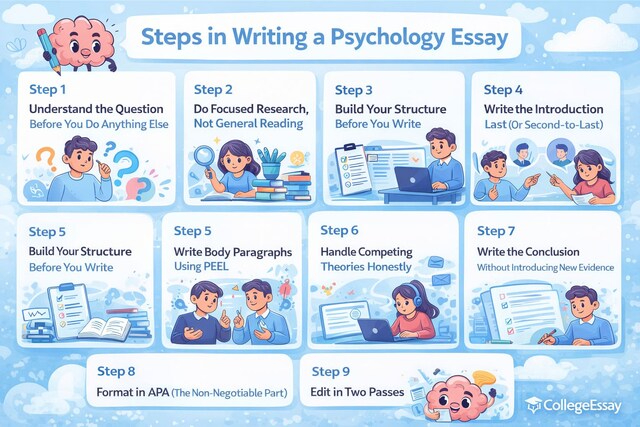
Step 1: Understand the Question Before You Do Anything Else
The single most common reason students lose marks on a psychology essay is writing a good essay that answers the wrong question.
Read the prompt three times. Then write down, in your own words, what the question is actually asking. Be specific. "Discuss the role of attachment in adult relationships" is asking you to evaluate, to look at evidence for and against, to weigh competing theories, to reach a supported conclusion. It is not asking you to describe attachment theory.
Identify the command word. Each command word tells you what structure your essay needs:
- Discuss / Evaluate: present multiple perspectives, weigh the evidence, reach a conclusion
- Critically analyse: examine the assumptions behind the research, not just the findings
- Compare: identify similarities and differences between two or more theories or studies
- Explain: demonstrate understanding of a mechanism or process, with evidence
- To what extent: argue a position along a spectrum, not just yes or no
Write the command word at the top of your working document and keep it visible. Every paragraph you write should be answerable to it.
Step 2: Do Focused Research, Not General Reading
Do not open a textbook and start reading from the beginning. That is how you end up with 40 pages of notes and no idea what to include.
Start with your thesis, a one-sentence answer to the essay question. It can be rough at this stage. Something like: "Attachment style in infancy is a significant but not deterministic predictor of adult relationship quality." That sentence tells you exactly what evidence you need.
Where to find credible sources:
- Google Scholar: free, covers most peer-reviewed journals
- PsycINFO (usually available via your university library login)
- PubMed: useful for biological and clinical psychology
- Your course reading list: always check this first; your lecturer included those papers for a reason
What makes a source credible in psychology:
- Published in a peer-reviewed journal
- Primary source (original study) is stronger than secondary source (a textbook describing the study)
- Recent publication for fast-moving fields (neuropsychology, clinical research); classic studies are acceptable for foundational theory
- Sample size and methodology should be visible, avoid citing studies with n=12 as though they are definitive
For a standard undergraduate essay, 8–12 sources is a reasonable range. You are not doing a literature review. You are building an argument, and every source should be doing a job.
For help finding psychology essay topics before you reach the research stage, see our guide to psychology essay topics, it covers topic selection by subfield and difficulty level. |
Step 3: Build Your Structure Before You Write
Most students skip this step. It is the most important one.
A psychology essay has a fixed architecture. What varies is the content inside it, not the shape.
The Structure
Introduction (10–15% of word count)
- Hook: one or two sentences that establish why this question matters
- Background: brief context — the key concepts the reader needs to understand before your argument starts
- Thesis: your position stated clearly
- Signpost: one sentence outlining how the essay will develop
Main Body (70–80% of word count)
- Each paragraph makes one point only
- PEEL structure per paragraph: Point, Evidence, Evaluation, Link
- Paragraphs build, each one advances the argument rather than introducing a parallel claim that sits alongside the previous one
Conclusion (10–15% of word count)
- Restate your thesis, but developed, not word-for-word repeated
- Summarise the evidence briefly
- Address limitations
- Final evaluative sentence, what does this mean? What does it not mean?
Write the structure out as bullet points before you open a new document. One bullet per paragraph, one sentence per bullet describing the argument that paragraph will make. If the bullets do not build into a coherent case, the structure is wrong, fix it before you start writing, not after.
Step 4: Write the Introduction Last (Or Second-to-Last)
This sounds counterintuitive. Write it anyway.
The introduction promises something to the reader: a specific argument, developed in a specific order. You cannot make that promise accurately until you know what your essay actually contains. Most introductions written first end up misrepresenting the essay that follows.
Write the body paragraphs first. Then write the conclusion. Then write the introduction based on what you actually wrote, not what you planned to write. |
Your thesis statement should appear in the final sentence of the introduction. It should be one clear, specific, arguable claim. If someone could respond "obviously" or "obviously not" without reading any evidence, your thesis is either too vague or not a thesis at all.
Step 5: Write Body Paragraphs Using PEEL
Every body paragraph in a psychology essay should do four things. PEEL keeps them in the right order.
Point: The argument this paragraph makes, in one sentence. This is your topic sentence. It should be a claim, not a fact. "Bowlby's attachment theory provides a framework for understanding how early caregiver relationships shape emotional regulation in adulthood."
Evidence: The research that supports the claim. Name the study, the year, and the key finding. "Hazan and Shaver (1987) found that adults who reported anxious attachment in infancy were significantly more likely to describe their romantic relationships as emotionally turbulent and fear-driven."
Evaluation: Critical engagement with the evidence. What are the limitations? What does a competing study say? What methodological problems should the reader know about? "However, this study relied on retrospective self-report measures, which are susceptible to recall bias and post-hoc rationalisation of early childhood experiences."
Link: Return the paragraph to your overall thesis. One sentence that explains how this point, with its evidence and limitations acknowledged, advances your argument. "Despite these methodological limitations, the convergence of findings across multiple attachment studies suggests a moderate and consistent relationship between early attachment security and adult relational outcomes."
The evaluation step is where most undergraduate essays fall short. Description is straightforward. Evidence is findable. But actively engaging with the weaknesses of your own argument, and still maintaining your position, is what separates a 2:1 from a first. |
Step 6: Handle Competing Theories Honestly
If your essay question uses the words "discuss," "evaluate," or "to what extent," you are required to engage with the strongest version of the opposing view, not a strawman version.
Find the best evidence against your thesis. Present it accurately. Then explain why, on balance, your thesis still holds, or refine your thesis to account for it.
This is called steel-manning, and in psychology essays it is what critical evaluation actually means. A marker reading a 2,500-word essay that presents only evidence in favour of one position is reading an essay that does not understand the standard of evidence required in the discipline.
Concrete example: if your essay argues that cognitive behavioural therapy is effective for treating depression, you need to engage with the evidence that CBT has high relapse rates compared to medication alone, and with the research showing that CBT's effectiveness varies significantly by depression severity and patient demographic. Then explain why, despite this, the overall evidence base still supports your thesis (or, if it doesn't, revise your thesis).
For examples of how this looks in practice, our psychology essay examples page shows real essays with commentary on how the argument is constructed and where marks were gained and lost. |
Still not confident you can argue both sides without your essay collapsing? Tell us your question, your word count, and your position, and our writers will write my psychology paper for you, argument, counterargument, and conclusion built in.
Step 7: Write the Conclusion Without Introducing New Evidence
The conclusion has one job: resolve your argument.
Do not introduce a new study in the conclusion. Do not open a new line of reasoning. Everything in the conclusion should be a distillation of what came before.
What a good psychology conclusion includes:
- Restatement of the thesis: developed, not copied
- Summary of the key evidence: brief, one sentence per main point
- Acknowledgement of limitations or counterarguments you could not fully resolve
- Evaluative final sentence: what can reasonably be concluded, and what cannot
The final sentence of your essay should not be a hedge or a cliché ("clearly more research is needed"). It should be a confident, qualified statement of what the evidence, as you have weighed it across this essay, actually supports.
Step 8: Format in APA (The Non-Negotiable Part)
Psychology uses APA formatting as standard. Most marks lost on formatting are lost on in-text citations and the reference list. Here is what you need to know.
In-text citations:
For a direct quote: (Author, Year, p. X) For a paraphrase: (Author, Year) For two authors: (Author & Author, Year) For three or more authors: (First Author et al., Year)
Reference list format (most common types):
Journal article: Author, A. A., & Author, B. B. (Year). Title of article. Name of Journal, volume(issue), page–page. https://doi.org/xxxxx
Book: Author, A. A. (Year). Title of work: Capital letter for subtitle. Publisher.
Chapter in edited book: Author, A. A. (Year). Title of chapter. In E. Editor (Ed.), Title of book (pp. XX–XX). Publisher.
Common APA mistakes that cost marks:
- Italicising the volume number but not the journal name (it's the journal name that's italicised)
- Putting "p." before page numbers in the reference list (you don't, only in in-text quotes)
- Capitalising every word in the article title (capitalise only the first word, proper nouns, and the first word after a colon)
- Missing the DOI when it is available
- Listing references in order of appearance rather than alphabetically
Run your reference list against the APA 7th Edition manual before you submit. If your university has a writing centre, they will usually check your reference list for free.
Step 9: Edit in Two Passes
First pass: argument and evidence. Read only for whether your case holds together. Does each paragraph make one clear point? Does each point build on the last? Does your conclusion follow from your body paragraphs? Is every claim supported? Cut anything that does not advance the argument, regardless of how well-written it is.
Second pass: language and clarity. Read aloud. Where you stumble, the sentence is too long or awkwardly structured. Replace passive constructions where possible. Remove filler phrases: "It is important to note that," "In today's society," "Needless to say." Every sentence should be doing work.
Specific things to check:
- Every psychological claim has a citation
- No citation appears in the introduction or conclusion (general rule some markers accept it, most do not)
- Your thesis appears in the introduction and is developed in the conclusion
- Your word count is within 10% of the limit (over and under both usually carry penalties)
- Your reference list is in alphabetical order by author surname
- You have not used first person unless the brief specifically allows it
What to Do If You Are Stuck Before You Start
Some students reach step three, building the structure, and hit a wall. The essay question is clear, the research is done, but the argument will not form. This is usually because the thesis is not specific enough to generate a structure.
If you cannot write one clear sentence saying what your essay will argue, you do not have a thesis yet. Go back to your sources. What does the weight of evidence actually say? What is contested? What is your position on the contested part?
If the problem is time, you understand the essay but the deadline is tomorrow and you have four other assessments this week, that is a different problem, and it has a different solution.
You have the structure. Writing a complete, APA-formatted, argument-driven psychology essay in 12–24 hours is exactly what our psychology paper writing service exists for. Tell us your question, your word count, your deadline, and any sources your lecturer requires, we handle the rest.
Choosing Your Psychology Degree Programme
If you are still deciding where to study, the university you choose will shape which psychological traditions and methodologies you spend the most time with.
The Short Version
A psychology essay is not a summary. It is an argument built from evidence, evaluated critically, and structured so that every paragraph earns its place.
The process: understand the question: build a thesis : find the evidence: structure before you write : PEEL every paragraph : steel-man the opposition : conclude without new evidence : format in APA : edit twice. |
Most students who struggle with psychology essays are not struggling because the subject is too hard. They are struggling because they are describing when they should be arguing, or writing without a structure because they skipped step three.
Follow the steps above and you will produce an essay that does what the examiner is looking for.
If you would rather hand the whole thing to someone who writes psychology papers every day, CollegeEssay.org psychology writers are available around the clock. Share your brief and get a complete, properly formatted paper back, typically within 12 hours for standard deadlines.