Computer Science Essay Examples by Format, Level, and Assignment Type
Computer science essay examples span argumentative, analytical, reflective, and research formats from high school through graduate level. Computer science application essays are personal narratives about the applicant’s thinking and motivations rather than arguments about a technical topic. Each example includes a structural breakdown showing what the essay argues, how the body paragraphs are organized, and what makes the format work so you can apply the same moves to your own assignment.
Written by David HernandezUpdated Jul 202626 min read14 free PDFs
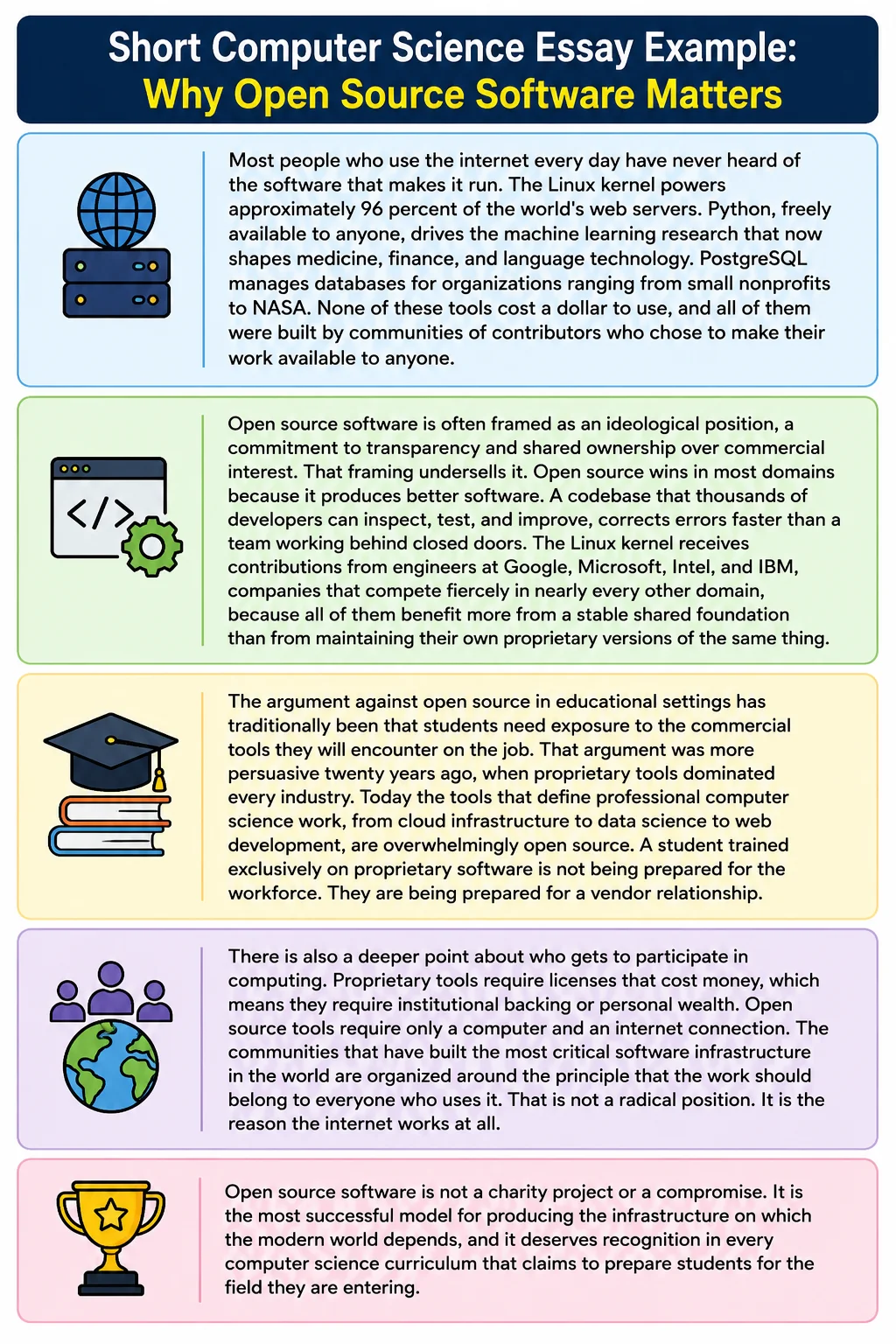
The short computer science essay example below runs approximately 400 words and uses an expository structure to argue that open source software underpins most of the internet’s critical infrastructure.
5 paragraph
5 Paragraph Computer Science Essay Example
The five paragraph computer science essay example below demonstrates how to build a thesis, three body paragraphs, and a conclusion within a 600 word limit on a cybersecurity policy argument.
Excerpt · Why Cybersecurity Education Should Be Required in Every High School | Level: High School | 600 words
Every student who graduates high school knowing how to analyze a primary source but not how to identify a phishing email has received an education that does not match the environment they are entering. Cybersecurity literacy, the ability to recognize social engineering, manage credentials securely, and understand basic network behavior, has become as foundational as financial literacy for daily life in a connected world. Yet most high school curricula treat it as an elective or ignore it entirely. Cybersecurity education should be required at the secondary school level not because every student will enter the field, but because every student will be targeted by those who have.
Computer Science Essay Examples by Type and Academic Level
Argumentative CS essays require a falsifiable thesis and a counterargument section; analytical essays require evaluation criteria declared before the comparison begins. A computer science essay thesis needs to be specific enough that a reader could argue the opposite position.
The examples below are grouped by format so you can match your assignment type before you start writing. Each entry includes an excerpt from the essay, a structural breakdown, and a PDF download.
If you have not settled on a topic yet, our guide to computer science essay topics covers scoped options across every CS subject area before you start.
Example 1Middle School Computer Science Expository Essay
Excerpt · The Role of Coding in Everyday Life | Level: Middle School
Most people use Google Maps every morning without thinking about the algorithm deciding whether to route them down Main Street or the highway. That decision involves graph theory, real time data, and a computational process running in under a second on a server hundreds of miles away. Coding is not a specialized skill confined to software companies; it is the mechanism behind nearly every tool a person touches before they leave their house.
Annotation
This essay explains how coding underpins tools students use daily, from navigation apps to recommendation algorithms, without requiring them to understand the code directly.
The introduction identifies a specific familiar technology and asks how it works. Body paragraphs each isolate one real world application, explain the underlying logic at a conceptual level, and connect back to why that matters for a general reader. The conclusion argues that basic coding literacy is no longer optional for any field.
The move worth borrowing: opening with a technology the reader already uses before moving to the concept. It earns attention before it asks for any.
Example 2High School Level Computer Science Argumentative Essay
Excerpt · Should AI Generated Content Be Subject to Copyright Law? | Level: High School
When a large language model generates a thousand word article, no human chose the words, structured the sentences, or made the aesthetic decisions that constitute authorship under United States copyright law. The Copyright Office has consistently held that copyright protection extends only to works with human authorship, and a 2023 federal court ruling confirmed that AI generated images could not be registered as copyrighted works. Extending copyright protection to AI output would not protect human creativity; it would transfer a legal monopoly over machine generated content to the companies that own the machines.
This essay argues that AI generated text and images cannot receive copyright protection because copyright law requires human authorship, and extending it to machine output would undermine the economic incentive structure copyright is designed to create.
Each body paragraph addresses one dimension of the debate: legal precedent, economic impact on human creators, and the question of who owns the model’s training data. A counterargument paragraph acknowledges the interests of companies that invest in AI development before refuting it on statutory grounds.
The move worth borrowing: the counterargument paragraph placed in the second half rather than at the start, which gives the thesis time to build before it is challenged.
Example 3High School Level Computer Science Analytical Essay
Excerpt · Algorithmic Bias in Hiring Software | Level: High School
In 2018, Amazon discontinued an experimental hiring tool after discovering it systematically downgraded resumes containing the word “women’s” and penalized graduates of all women’s colleges. The tool had been trained on a decade of the company’s own hiring decisions, a dataset that reflected the male dominated composition of the tech workforce rather than any objective assessment of candidate quality. This case illustrates a fundamental problem in automated decision making systems: a model trained on biased historical data does not learn to evaluate candidates; it learns to replicate the biases of the humans who made the decisions before it.
This essay uses a fairness framework to examine how automated resume screening tools systematically disadvantage applicants from underrepresented groups.
Body sections each examine one mechanism through which bias enters the system, from biased training data to proxy variables that encode protected characteristics. The conclusion argues that technical fixes alone are insufficient without regulatory oversight.
The move worth borrowing: using a framework from a different discipline to structure the analysis. It gives the argument intellectual coherence without requiring the writer to invent an evaluative standard from scratch.
Example 4College Level Computer Science Argumentative Essay
Excerpt · Open Source vs. Proprietary Software in University Education | Level: Undergraduate
A student who learns to code in a university environment built around proprietary tools graduates with skills tied to a licensing agreement, not to the underlying concepts. When that license expires or the company changes its pricing structure, the practical knowledge becomes contingent on commercial access that the student cannot guarantee. Universities teaching CS have an obligation to their students that extends past graduation, and that obligation is better served by tools whose availability does not depend on a vendor’s continued goodwill.
This essay argues that universities teaching CS should default to open source tools because proprietary software creates vendor dependency, restricts student access after graduation, and distorts the curriculum toward commercially popular rather than educationally sound choices.
The introduction defines the scope precisely: not all software in all contexts, but specifically the software used in core CS instruction. The counterargument section acknowledges that industry exposure to proprietary tools has real career value before qualifying that benefit against its costs.
The move worth borrowing: a precisely scoped thesis. “Universities should use open source software” is too broad. “Universities teaching core CS courses should default to open source tools” is arguable, testable, and defensible.
CollegeEssay.org connects students with CS specialist writers who match the assignment format, course level, and citation style required.
Example 5College Level Computer Science Analytical Essay
Excerpt · Evaluating the Efficiency of Sorting Algorithms Under Specific Data Conditions | Level: Undergraduate
The performance gap between quicksort and merge sort disappears under nearly sorted input and reappears dramatically under random large datasets. Measuring algorithmic efficiency in a single condition produces results that are technically accurate but practically misleading. An evaluation rubric that tests each algorithm across four distinct data conditions reveals a more complete picture of when each algorithm should be applied and when it should not.
This essay compares three sorting algorithms across four data conditions: random input, nearly sorted input, reverse sorted input, and data with many duplicates. The introduction states which algorithms are being evaluated and which efficiency metric is used.
Each body section presents one data condition, reports the results, and explains why the algorithm’s structure produces that outcome.
The move worth borrowing: the conditional conclusion. Rather than declaring one algorithm universally superior, it specifies the conditions under which each excels. That precision is what analytical essays reward.
Example 6College Level Computer Science Reflective Essay
Excerpt · What Debugging Taught Me About Structured Problem Solving | Level: Undergraduate, Intro Course
The error message read “null pointer exception at line 47,” and I had been staring at line 47 for forty minutes. The bug was not at line 47; it was in a helper function sixty lines earlier that returned null under a conditional I had not tested. The experience taught me something no textbook had covered explicitly: debugging is not about finding where the program breaks. It is about forming a hypothesis about why it breaks and designing a test that can falsify that hypothesis.
This essay uses a specific debugging session from a data structures assignment as the anchor for a broader argument about the value of systematic rather than intuitive problem solving. The body paragraphs move between the specific debugging steps taken and the general principle each step illustrates. The conclusion connects the debugging methodology to professional software development practice.
The move worth borrowing: the oscillation structure, moving between the specific event and the general insight in each paragraph, rather than narrating the event first and extracting the lesson only at the end.
Example 7University Level Computer Science Research Essay
Excerpt · Machine Learning Applications in Early Disease Detection | Level: Undergraduate to Graduate
A 2020 study published in Nature Medicine reported that a deep learning model trained on chest scans detected pneumonia with 94.5 percent accuracy, compared to 88 percent for the radiologists in the same study. The result generated significant coverage as evidence that machine learning had surpassed human clinical judgment in at least one diagnostic domain. A closer examination of the methodology reveals important qualifications: the radiologists worked under a time constraint of 1.5 minutes per image, the training dataset came from a single hospital system, and the model’s performance on images from other institutions dropped to 73 percent.
This essay surveys peer reviewed literature on ML applications in radiology, oncology, and cardiology, synthesizing what the evidence shows about accuracy rates, false positive rates, and deployment barriers. The literature review is organized thematically by medical domain rather than chronologically.
Each section evaluates the strength of evidence in that domain against a consistent set of criteria: sample size, validation method, and comparison against clinician performance.
The move worth borrowing: the consistent evaluation rubric applied across every source. It transforms a literature summary into an analysis.
Example 8IB Extended Essay
Excerpt · The Ethical Implications of Facial Recognition Technology in Public Surveillance | Level: IB, High School Senior
The deployment of facial recognition technology in public spaces has outpaced the legal frameworks designed to govern it. In 2019, London expanded its live facial recognition program to public events, with an accuracy rate later reported as 81 percent, meaning roughly one in five identifications produced a false match. Under the proportionality principle established in Article 8 of the European Convention on Human Rights, a surveillance measure is only justifiable if its benefits are proportionate to the privacy cost it imposes. An 81 percent accuracy rate applied to a crowd of ten thousand people generates two thousand false identifications per event, a number that fails the proportionality test regardless of whether the underlying law permits the deployment.
This extended essay argues that mass deployment of facial recognition in public spaces violates the proportionality principle in human rights frameworks. The body is organized around three case studies from different national contexts, each analyzed through the same proportionality framework. A section on technical limitations addresses accuracy disparities across demographic groups, connecting the technical evidence to the ethical argument.
The move worth borrowing: grounding the ethical argument in a defined philosophical framework rather than intuition. The proportionality principle gives the essay a standard that can be applied consistently across different cases.
Reviewing examples shows you the standard. Applying that structure to your own argument under a deadline is a different challenge. If the format still is not clicking or the thesis is not coming together, our professional essay writing services for your subject pair you with a computer science specialist who builds the essay around your prompt, your course level, and your brief.
Example 9Undergraduate Cybersecurity Argumentative Essay
Excerpt · The Ethical Case for Penetration Testing Without Full Disclosure | Level: Undergraduate
The security researcher who discovers a critical vulnerability in widely deployed software faces a decision with no good options. Immediate public disclosure allows defenders and attackers to respond simultaneously; coordinated disclosure through the vendor delays public knowledge but risks the vendor’s failure to patch in good faith. This essay argues that neither model is adequate as a universal standard, and that the appropriate disclosure timeline should be calculated as a function of the estimated patch deployment rate across affected systems rather than fixed at an arbitrary number of days.
This essay argues that ethical penetration testers are sometimes justified in withholding technical vulnerability details from the general public even after a fix is deployed, because premature disclosure enables exploitation before patching reaches all affected systems.
The introduction distinguishes between responsible disclosure, coordinated disclosure, and full public disclosure. Body paragraphs address the competing obligations to the public, to affected organizations, and to the broader security research community.
The move worth borrowing: acknowledging that the essay is arguing for a framework rather than a rule. It allows the essay to engage with complexity without undermining its central claim.
Example 10Undergraduate Big Data and Privacy Essay
Excerpt · How Behavioral Data Collection Challenges the Informed Consent Model | Level: Undergraduate
When a user clicks “I agree” on a cookie consent banner, they consent to data collection as it exists at that moment, not to the uses that data will serve three years later when it is sold to a third party, combined with purchase history from a different platform, and used to determine their insurance risk score. The informed consent model borrowed from medical ethics assumes that a patient can meaningfully evaluate the risks of a procedure they are consenting to today. Behavioral data does not work that way; its value derives from aggregation across time and across sources that the user cannot anticipate at the moment of consent.
This essay argues that the informed consent model is structurally inadequate for governing behavioral data collection at scale because consent to data collection and consent to data use are not the same thing, and current frameworks conflate them.
Body sections each examine one dimension of the inadequacy: the complexity of privacy policies, the impossibility of anticipating downstream uses at the time of consent, and the aggregation problem. The conclusion proposes a regulatory model based on data use as an alternative.
The move worth borrowing: diagnosing a conceptual mismatch before proposing a solution.
Example 11Undergraduate Computer Science Comparative Essay
Excerpt · Python vs. Java as a First Programming Language for Undergraduate CS Students | Level: Undergraduate
Python’s syntax reduces the cognitive overhead of learning to program for one straightforward reason: it removes the requirement that beginners understand memory management, type declarations, and compilation before they can execute their first program. A student who wants to print a variable to the screen in Python writes two words. The same operation in Java requires defining a class, declaring a main method, and wrapping the output call in a class structure that serves no conceptual purpose until the student understands object oriented programming. That gap in initial complexity has measurable consequences for student retention in introductory courses.
This essay evaluates both languages against four criteria: readability for beginners, alignment with industry demand, suitability for teaching core CS concepts, and transition cost when moving to lower level languages.
The introduction is explicit about the criteria before any comparison begins. The essay concludes that Python is the better introductory choice for most programs with a clear explanation of which program types would be better served by Java.
The move worth borrowing: declaring the evaluation criteria in the introduction. It makes the comparison auditable: a reader who disagrees with the conclusion can identify exactly which criterion they would weight differently.
Introductions
Computer Science Essay Introduction Examples
A strong computer science essay introduction establishes why the topic matters right now, identifies the specific gap the essay addresses, and states a thesis precise enough that a reader knows what will be argued.
The two examples below show how that structure works across different essay formats. CollegeEssay.org’s writing team reviews CS essays across argumentative, analytical, and reflective formats and finds that most introduction failures come from a thesis stated too broadly to be arguable.
Introduction Example 1Argumentative CS Essay
Topic: AI Generated Content and Copyright Law | Level: Undergraduate
The question of whether AI generated content deserves copyright protection arrived in federal court before most legal scholars had finished writing their first papers on the subject. In 2023, a federal district court ruled that images produced without human authorship could not be registered as copyrighted works, but the ruling left open the larger question of what happens when a human provides the prompt, curates the output, and publishes the result. This essay argues that copyright protection should not extend to AI generated content regardless of the level of human involvement in the prompting process, because doing so would fundamentally alter the incentive structure copyright law was designed to create and concentrate legal monopolies over cultural production in the companies that own the largest models.
This introduction earns its reason to exist by identifying what existing rulings leave unresolved rather than restating the general debate. It moves from established fact (the 2023 ruling) to an open question (the role of human prompting) to a specific thesis in three sentences.
The thesis is precise enough to be falsifiable: it does not say “AI and copyright is complicated” but makes a clear claim about where the line should be drawn and why.
Introduction Example 2Analytical CS Essay
Topic: Sorting Algorithm Efficiency Across Data Conditions | Level: Undergraduate
Measuring algorithmic efficiency with a single benchmark produces results that are technically correct and practically useless. A sorting algorithm that performs optimally on random data may become the worst choice for nearly sorted input, and an algorithm dismissed as slow in textbook comparisons may outperform all alternatives when duplicates dominate the dataset. This analysis evaluates quicksort, merge sort, and insertion sort across four distinct data conditions to determine which algorithm a developer should reach for first in each scenario.
This introduction turns a critique of the standard approach into the justification for the essay’s methodology. It identifies the flaw in how efficiency is typically measured, shows that the flaw has real consequences, and then states what the essay will do differently.
The thesis is narrow and specific: not “which algorithm is best overall” but “which algorithm to use in which scenario.” That scoping is what makes an analytical essay arguable rather than descriptive.
Conclusions
Computer Science Essay Conclusion Examples
The strongest computer science essay conclusions restate the thesis in light of the evidence, address the most important implication, and end with a specific observation that extends the argument rather than repeating it.
Conclusion Example 1Argumentative CS Essay
Topic: Cybersecurity Education in Secondary Schools | Level: High School to Undergraduate
The case for mandatory cybersecurity education in secondary schools does not rest on the possibility that every student will enter the field. It rests on the certainty that every student will be targeted by people who have. The barriers to implementing such a curriculum are real but not unique: the same objections were raised against financial literacy requirements and computer science mandates, and both have been addressed through curriculum development, teacher training programs, and industry partnerships. The question is no longer whether secondary schools can teach cybersecurity. It is whether they will choose to before the next generation of students reaches adulthood having never been told that the most common entry point for a data breach is a person who did not know what a phishing email looked like.
This conclusion reframes the central claim before restating it, disposes of the strongest counterargument in a single sentence by pointing to precedent, and ends with a specific image rather than a general call to action.
The closing sentence does not summarize the essay; it extends the argument into a consequence the reader has not yet considered. That move makes the ending feel like an arrival rather than a repetition.
Conclusion Example 2Research CS Essay
Topic: Machine Learning Applications in Disease Detection | Level: Undergraduate to Graduate
The evidence reviewed here supports a narrower claim than the headlines surrounding AI diagnostic tools typically assert: machine learning models can match or exceed clinician performance in controlled conditions on specific imaging tasks when evaluated on data drawn from the same distribution as their training set. That qualification matters enormously for deployment decisions. A model with 94 percent accuracy on a validation sample from a single hospital system is not a model with 94 percent accuracy in clinical practice across diverse patient populations. The path from promising research results to responsible deployment requires expanded validation across multiple sites, transparent reporting of performance by demographic subgroup, and regulatory frameworks that treat diagnostic AI as the medical device it functionally is rather than the software product it legally resembles.
This conclusion opens by precisely restating what the evidence actually shows, then distinguishes it from the broader claim often made about that evidence, and uses that distinction to motivate a specific policy direction.
Starting the conclusion by narrowing the claim rather than expanding it signals intellectual honesty and gives the recommendations that follow more credibility. A research essay conclusion that overstates its findings undermines everything that came before it.
Admission
Computer Science Admission and Application Essay Examples
Computer science application essays differ from academic essays in one fundamental way: the argument is about you, not about a CS topic. Where an academic essay asks you to analyze a technology or defend a position, an application essay asks an admissions reader to understand why you think the way you do and why CS is the field through which you have chosen to do it.
1Why Computer Science Essay Examples
Example A: Why Computer Science Essay
Excerpt · Finding a Technical Solution to a Non Technical Problem | Supplemental Essay, 350 words
My younger sister is deaf and relied on auto generated captions during the school closures in 2020. The captions were wrong often enough that she missed material in three of her five classes. I had been learning Python for eight months, and I understood enough about natural language processing to recognize that the problem was not technically unsolvable. It was that nobody with the skills to solve it had prioritized her use case.
The essay opens with the writer’s younger sibling struggling to find accessible educational videos during a school closure. The body moves through three phases: the writer’s initial search for existing tools, the recognition that nothing accessible existed, and the steps they took to build a basic video recommendation script. The conclusion connects that project to the applicant’s intended focus in human computer interaction research.
The move worth borrowing: the problem arrives before the solution. CS appears as the answer to a real need, not as an existing passion looking for a narrative to justify it.
Example BWhy Computer Science Essay
Excerpt · Using Code to Model What Statistics Could Not Capture | Common App Short Answer, 250 words
In my AP Statistics class junior year, we spent three weeks on linear regression. The model I was building was supposed to predict student performance based on study hours, but every time I added a behavioral variable, sleep quality, anxiety level, phone use, the model’s predictive power dropped rather than improved. The residuals were not random; they were patterned in a way that suggested the relationship I was trying to model was not linear, and linear regression had no way to tell me that.
The essay opens in a statistics class where the writer notices the model cannot account for a behavioral variable they were studying. The body describes the decision to build a simulation instead and what it revealed that the statistical approach had missed. The conclusion argues that CS is the discipline through which the writer intends to approach problems that resist standard analytical frameworks.
The move worth borrowing: CS is framed as a tool for a specific kind of thinking rather than as an interest to be declared.
Common App
Computer Science Common App Essay Examples
Common App essays are personal narratives, not CS content essays. The major does not need to be mentioned at all. What the admissions reader is evaluating is intellectual character: how the applicant thinks through a problem, how they handle failure or difficulty, what they care about and why.
Pattern 1The debugging metaphor essay
Excerpt
The error had no business being there. I had reviewed the code three times, and every time I read it, the logic looked correct. The program was supposed to convert a list of student scores into letter grades and output a report, and instead it was silently dropping every score below 60 and reporting a perfect class average. It took me two days and a rubber duck, an actual rubber duck propped against my monitor, to realize I had written the wrong comparison operator.
The essay uses a specific technical challenge as the literal subject, but the essay is actually about the applicant’s relationship with failure and persistence. The CS context is the vehicle, not the destination. The essay works when the insight in the conclusion is genuinely surprising and specific to the writer rather than a generic lesson about not giving up.
Pattern 2The unconventional angle essay
Excerpt
My grandmother keeps her recipe book in a three ring binder with handwritten tabs and no index. For twenty years she has known exactly where everything is by feel alone, the way experienced programmers navigate a large codebase without a map. When she asked me to digitize the recipes, I realized I was not just transcribing text. I was designing an information architecture for someone who had already built a perfectly functional one.
The essay addresses a topic entirely unrelated to CS but reveals the applicant’s analytical thinking style through how they approach it. Admissions readers remember these because they demonstrate how the applicant’s mind works rather than cataloguing achievements.
You now have structural models for every essay type your assignment or application might require, and a breakdown of what admission readers look for in CS application essays. The next problem is turning that understanding into a finished draft before the deadline. Our essay writing services by subject connect you with a verified CS writer who works to your brief, your citation style, and your submission date.
Scholarship
Computer Science Scholarship Essay Examples
Strong computer science scholarship essays demonstrate academic trajectory in the field and explain how the applicant intends to use CS for community benefit.
Pattern 1Challenge into solution
Excerpt
The community center in my neighborhood lost its grant for after school tutoring in 2022, and the coordinator asked me if I knew any free tools that could help students practice math independently. Everything I found required a reliable internet connection that most students in the area did not have. I spent the following summer building an offline application that could deliver adaptive math practice without a data connection.
The essay opens with a specific challenge the applicant or their community faced, then explains how the applicant used CS skills to address it, then connects the project to a broader impact. The mistake most scholarship essays make is spending too much time on the challenge and too little on the technical substance of the solution.
Pattern 2Research into impact
Excerpt
My independent research project began with a simple question: could a convolutional neural network trained on satellite imagery reliably detect the early signs of crop disease before they were visible to field surveyors? The model I built, trained on publicly available Sentinel 2 data and a labeled dataset from an agricultural university, achieved 87 percent accuracy on a held out validation set, roughly equivalent to the performance of an experienced agronomist reviewing the same imagery, at a fraction of the cost.
The essay opens with a specific research interest or project, explains what the work involves technically and what it has produced, then explains who benefits and why the scholarship would allow the applicant to pursue it further. This pattern works best for applicants with genuine research experience or a specific project to describe.
Computer science essays test both technical knowledge and the ability to argue clearly, which is why most students hit a wall somewhere between the outline and the second body paragraph. If that is where you are, CollegeEssay.org subject-specific services gives you a writer who understands the field and can take the essay from stuck to submission-ready.
FAQ
Frequently Asked Questions
Most undergraduate computer science essays run between 1,000 and 2,500 words, though the length varies by course level, essay type, and institution. High school CS essays typically fall in the 500 to 800 word range. Graduate level research papers extend further depending on the scope of the survey or argument. Always check the assignment brief before assuming a word count.
Computer science essays most commonly use IEEE citation style for technical courses or APA style for papers covering the social, ethical, or policy dimensions of computing. IEEE uses numbered references in order of appearance. APA uses author and date in the text. Confirm the required style with your professor before writing, as mixing styles is one of the most penalized errors in CS academic writing. CollegeEssay.org writers confirm the required citation style with students before drafting because IEEE and APA produce structurally different reference lists.
Computer science application essays are personal narratives about the applicant’s thinking and motivations rather than arguments about a technical topic. Application essays are evaluated for intellectual character and specificity of interest rather than for technical accuracy. The admissions reader wants to understand why this applicant chose CS, not what they know about it.
Start a why computer science essay with a specific moment rather than a general interest statement. A specific debugging session, a robotics competition failure, a problem in your community that turned out to have a computational dimension: these make stronger opening scenes than a general declaration of interest in computers or technology. The moment should be precise enough that a reader who did not know you could picture it.
Yes, but only as a learning resource. Use examples to understand formatting, organization, and writing style while creating an original essay based on your own research and analysis.
Yes. Computer science essay examples can provide guidance on organizing research papers, presenting technical concepts, supporting arguments with evidence, and following academic writing conventions.
D
Written by
David Hernandez Verified Writer
David is a tech expert who writes clear, detailed essays on complex topics. He has helped many engineering students explain their skills and goals in a way that makes sense to reviewers. His work is strong and to the point.