You have a classification essay due, and your professor wants an outline first. This page gives you the exact structure to follow: a template you can copy, fill in, and submit, plus a fully worked example so you can see what a finished outline looks like before you build your own. It is part of our broader guide on the types of essays. If you are not yet clear on what a classification essay actually is, that is the right place to start.
Classification Essay Outline: A Template You Can Actually Use
What Goes Into a Classification Essay Outline
A classification essay does one thing: it takes a broad subject, breaks it into distinct categories, and explains each one using a consistent principle. The outline is what keeps that structure from collapsing.
Before you fill in a single line, you need three things locked in:
- Your subject. What are you classifying? Dogs. Study habits. Movie villains. Social media users. It needs to be broad enough to have multiple categories but specific enough that the categories mean something.
- Your classification principle. The single criterion you're using to sort your subject into groups. Dogs classified by size. Study habits classified by effectiveness. Movie villains classified by motivation. Every category must flow from the same principle. Mixing principles is the most common structural mistake in this essay type compared to other types of essays.
- Your categories. Most classification essays use three. You can use more, but each one needs to be genuinely distinct from the others, and each one needs enough to say about it to fill a body paragraph.
Once you have those three things, the outline writes itself.
The Classification Essay Outline Template
This is the standard five-paragraph structure for a classification essay. Copy it, replace the bracketed placeholders with your content, and you have a working outline.
INTRODUCTION
- Hook: one sentence that pulls the reader in
- Background: 1-2 sentences establishing the subject and why it's worth classifying
- Thesis statement: names the subject, the classification principle, and the three categories
BODY PARAGRAPH 1: [Category 1]
- Topic sentence: names Category 1 and connects it to the classification principle
- Definition: what makes something belong to this category
- Characteristics: 2-3 traits that define this category
- Example: one specific, concrete example that fits this category
- Transition: bridges to Category 2
III. BODY PARAGRAPH 2: [Category 2]
- Topic sentence: names Category 2 and connects it to the classification principle
- Definition: what makes something belong to this category
- Characteristics: 2-3 traits that define this category
- Example: one specific, concrete example that fits this category
- Transition: bridges to Category 3
III. BODY PARAGRAPH 3: [Category 3]
- Topic sentence: names Category 3 and connects it to the classification principle
- Definition: what makes something belong to this category
- Characteristics: 2-3 traits that define this category
- Example: one specific, concrete example that fits this category
- Transition: bridges to conclusion
IV. CONCLUSION
- Restatement of thesis: in different words from the introduction
- Summary: one sentence per category, pulling out the key point
- Closing thought: why this classification matters, or what the reader should take away
That is the skeleton. Every classification essay, regardless of topic or length, fits inside this frame.
How to Write a Thesis Statement for a Classification Essay Outline
The thesis is the one sentence that holds the entire outline together. A weak thesis produces a weak essay. A strong thesis makes every body paragraph easier to write because it tells you exactly what each one has to do.
Thesis formula: [Subject] can be classified into [number] categories based on [classification principle]: [Category 1], [Category 2], and [Category 3].
It is not the only way to phrase a thesis, but it is the clearest. If your thesis can't fit this formula loosely, your classification principle probably isn't solid yet.
Weak thesis: There are many different types of students in a classroom. No principle. No categories named. Tells the reader nothing about what the essay will actually argue. |
Strong thesis: Students can be classified into three categories based on their approach to deadlines: planners who work ahead, procrastinators who work under pressure, and avoiders who rarely submit on time. Principle is clear (approach to deadlines). Three categories named. Each one is genuinely distinct. The body paragraphs write themselves from this sentence. |
The same thesis formula applies to other essay types that rely on structured categorization. If your assignment is a definition essay, the thesis works differently: it identifies a term and commits to a specific interpretation rather than naming a set of categories. Worth knowing if you have both due in the same week.
A Fully Worked Example for a Classification Essay Outline
Subject: Coffee drinkers
Classification principle: Reason for drinking coffee
Categories: The ritual drinker, the functional drinker, the enthusiast
I. INTRODUCTION
- Hook: Every morning, millions of people reach for a cup of coffee, but almost none of them are reaching for the same thing.
- Background: Coffee is one of the most consumed beverages in the world, but the reasons people drink it vary widely. Understanding those reasons reveals three fundamentally different relationships with the same drink.
- Thesis: Coffee drinkers can be classified into three categories based on why they drink it: the ritual drinker, the functional drinker, and the enthusiast.
II. BODY PARAGRAPH 1: The Ritual Drinker
- Topic sentence: The ritual drinker drinks coffee not for the caffeine or the flavor, but for the routine it anchors.
- Definition: A ritual drinker is someone for whom coffee is primarily a habit marker that signals the start of the day or a transition between activities.
- Characteristics:
- Drinks at the same time every day
- Has a specific preparation method they repeat exactly
- Would feel the day was "off" if the cup didn't happen, regardless of caffeine
- Example: Someone who makes a French press every morning at 6:45 AM before sitting quietly for 20 minutes, and describes skipping it as "ruining the morning.
- Transition: Unlike the ritual drinker, the functional drinker has a purely instrumental relationship with coffee.
III. BODY PARAGRAPH 2: The Functional Drinker
- Topic sentence: The functional drinker drinks coffee as a performance tool. The goal is alertness, not experience.
- Definition: A functional drinker treats coffee the way an athlete treats a supplement: the outcome matters, the process does not.
- Characteristics:
- Drinks whatever is fastest or most convenient
- Monitors caffeine intake in relation to output (studying, working, training)
- Has no preference for origin, roast, or preparation method
- Example: A graduate student who drinks two large drip coffees from the campus dining hall before a long study session and could not identify the roast if asked.
- Transition: Where the functional drinker wants results, the enthusiast wants the experience itself.
IV. BODY PARAGRAPH 3: The Enthusiast
- Topic sentence: The enthusiast drinks coffee for the coffee. The origin, the process, and the flavor are the point.
- Definition: An enthusiast is someone whose relationship with coffee is closer to a hobbyist than a consumer. The drink is worth learning about, discussing, and seeking out.
- Characteristics:
- Knows origin countries, processing methods, and roast profiles
- Owns multiple brewing devices and adjusts variables between cups
- Seeks out specialty roasters and can distinguish flavor notes
- Example: Someone who orders a natural-process Ethiopian single origin, brews it in a Chemex at a specific water temperature, and takes notes on the cup.
- Transition: Together, these three types show that coffee means something fundamentally different depending on who is drinking it.
V. CONCLUSION
- Restatement of thesis: When sorted by motivation rather than consumption habit, coffee drinkers fall into three distinct groups: those who drink for routine, those who drink for function, and those who drink for the experience.
- Summary:
- The ritual drinker uses coffee to anchor the day.
- The functional drinker uses it to perform.
- The enthusiast uses it to engage with something they love.
- Closing thought: The same cup of coffee means entirely different things to different people, and understanding that difference is exactly what classification writing is built to reveal.
Still working out how to fit your topic into this structure? Share your subject, your classification principle, and your deadline. Professional classification essay writing from our team means you get a complete, structured essay back rather than a skeleton to fill in on your own.
A Second Worked Example of a Classification Essay Outline: Academic Topic
Subject: Approaches to ethical decision-making
Classification principle: The basis on which a person decides what is right
Categories: The rule-follower, the consequentialist, the virtue-based reasoner
I. INTRODUCTION
- Hook: When two people face the same moral dilemma and reach opposite conclusions, the disagreement is rarely about the facts. It is about the framework each person is using to decide.
- Background: Ethical decision-making is not a single process. People reason toward what is "right" using fundamentally different foundations, and understanding those foundations explains why moral disagreements are so persistent.
- Thesis: Approaches to ethical decision-making can be classified into three categories based on the basis for judgment: the rule-follower, who applies fixed principles; the consequentialist, who evaluates outcomes; and the virtue-based reasoner, who asks what a person of good character would do.
II. BODY PARAGRAPH 1: The Rule-Follower
- Topic sentence: The rule-follower determines right from wrong by applying a fixed set of principles, regardless of outcome.
- Definition: A rule-follower believes that certain actions are inherently right or wrong. The consequences of following the rule are secondary to the rule itself.
- Characteristics:
- Derives principles from a fixed source (religious doctrine, legal code, Kantian duty)
- Applies rules consistently across situations without exception
- Regards outcome-based justifications as a form of rationalization
- Example: A journalist who refuses to reveal a source even when doing so would prevent harm, on the grounds that confidentiality is an unconditional professional obligation.
- Transition: Where the rule-follower looks to principle, the consequentialist looks to what the principle actually produces.
III. BODY PARAGRAPH 2: The Consequentialist
- Topic sentence: The consequentialist judges an action by its results. The right choice is the one that produces the best outcome for the most people.
- Definition: A consequentialist treats morality as a calculation. Actions have no inherent moral value; their value is determined entirely by what they bring about.
- Characteristics:
- Weighs the probable outcomes of all available options before deciding
- Treats rules as useful guidelines rather than absolute constraints
- Is willing to accept a harmful action if it prevents greater harm
- Example: A public health official who mandates an unpopular policy because the modelled outcomes show it will save more lives than any available alternative, despite significant individual hardship.
- Transition: Unlike the consequentialist, the virtue-based reasoner does not begin with rules or outcomes. They begin with character.
IV. BODY PARAGRAPH 3: The Virtue-Based Reasoner
- Topic sentence: The virtue-based reasoner asks not "what is the rule?" or "what produces the best result?" but "what would a person of good character do?"
- Definition: Virtue-based reasoning locates morality in the agent rather than in the action. The goal is to cultivate and express virtues such as honesty, courage, and compassion.
- Characteristics:
- Evaluates decisions through the lens of personal character and moral development
- Allows for contextual judgment. The same virtue may express itself differently in different situations.
- Treats moral growth as a lifelong practice rather than a decision procedure
- Example: A manager who, faced with a difficult redundancy decision, consults not only legal requirements and business outcomes but asks what a fair, compassionate, and honest leader would do in this specific situation.
- Transition: Together, these three frameworks show that ethical disagreement is often not about values but about the method of moral reasoning each person has internalized.
V. CONCLUSION
- Restatement of thesis: Ethical decision-making divides into three approaches based on where a person locates the source of moral authority: in fixed rules, in outcomes, or in character.
- Summary:
- The rule-follower applies principles without exception.
- The consequentialist calculates the best result.
- The virtue-based reasoner asks what good character demands.
- Closing thought: No single framework has resolved every moral question in the history of philosophy, which is precisely why understanding all three is more useful than committing to one.
How to Adapt the Classification Essay Outline Template to Your Topic
The template above works for any subject. Three steps to make it yours:
- Step 1: Lock your classification principle before anything else. If you start filling in categories before the principle is clear, the categories will drift. Write the principle in one sentence and test every category against it. If a category doesn't flow directly from the principle, it doesn't belong.
- Step 2: Make sure your categories don't overlap. Each category needs a clear boundary. If a reader could put the same example into two different categories, your categories aren't distinct enough. Tighten the definitions until the boundaries are clean.
- Step 3: Give every category the same depth. If one body paragraph has four specific characteristics and another has one vague sentence, the essay feels unbalanced. Your outline should show roughly equal weight across all three body paragraphs before you write a word of the essay itself.
Classification Essay Outline: Extended Version (5+ Categories)
The five-paragraph structure works for three categories. If your assignment requires more, or if your topic genuinely needs four or five distinct groups, the outline expands by adding body paragraphs. The logic stays identical; only the count changes.
INTRODUCTION
- Hook
- Background
- Thesis: names subject, principle, and all categories (four or five)
II. BODY PARAGRAPH 1: [Category 1]
[Topic sentence, definition, characteristics, example, transition]
III. BODY PARAGRAPH 2: [Category 2]
[Topic sentence, definition, characteristics, example, transition]
IV. BODY PARAGRAPH 3: [Category 3]
[Topic sentence, definition, characteristics, example, transition]
V. BODY PARAGRAPH 4: [Category 4]
[Topic sentence, definition, characteristics, example, transition]
VI. BODY PARAGRAPH 5: [Category 5, if applicable]
[Topic sentence, definition, characteristics, example, transition]
VII. CONCLUSION
- Restatement of thesis
- One-sentence summary per category
- Closing thought
One practical note: most professors who ask for a classification essay expect three categories unless the assignment prompt specifies otherwise. If you're planning to use four or five, confirm it's acceptable before you build the outline. Restructuring after the outline is done is far easier than restructuring after the essay is written.
Division and Classification Essay Outline
Some assignments phrase this as a "classification and division" essay. The structure is the same. The distinction is in emphasis:
- Classification groups items that already exist into categories (classifying types of learners, types of customers, types of athletes).
- Division breaks a single whole into its component parts (dividing a novel into its narrative elements, dividing a corporation into its departments).
In practice, most assignments use both moves together. You divide a subject into parts and then classify those parts. The outline template above handles both. The only adjustment is in how you write the thesis: for a division essay, the thesis identifies the whole and names the parts rather than naming the classification principle.
Division thesis example: A successful job interview can be divided into three phases: preparation before the interview, performance during it, and follow-through after it.
Same outline structure. Same body paragraph template. Just a different framing at the thesis level.
Classification Essay Outlines by Essay Length
Short Essay (500–700 words): 3 Body Paragraphs, 1 Example per Category.
Follows the standard five-paragraph template above. One example per category is enough. The characteristics section can be reduced to 2 traits per category.
Medium Essay (800–1,200 words): 3 Body Paragraphs, 2 Examples per Category.
Body paragraph internal structure:
- Topic sentence
- Definition
- Characteristics (2-3)
- Primary example: your strongest, most specific example
- Secondary example: a contrasting or reinforcing case
- Analysis: one sentence explaining what these examples reveal about the category
- Transition
Long Essay (1,500+ words): 4–5 Body Paragraphs or Deeper Treatment per Category.
At this length, each body paragraph can carry its own mini-structure: definition, distinguishing characteristics, a primary example with analysis, a secondary example with analysis, and a sentence on limitations or edge cases. The outline becomes more granular, but the principle stays the same: every element traces back to the classification principle stated in the thesis.
The next step is writing the essay itself: turning the skeleton into paragraphs with real sentences, transitions that don't feel mechanical, and a thesis that holds under pressure. If that's where things get harder, have our classification essay writers build this out from your outline or from scratch. Give us your subject, your categories, and your deadline. Most students get a complete draft back within 24 hours. |
Three Classification Essay Outline Mistakes That Collapse the Essay
Getting the outline wrong at the structural level means the essay can't be fixed by better writing. These are the three most common errors and how to catch them before you start drafting.
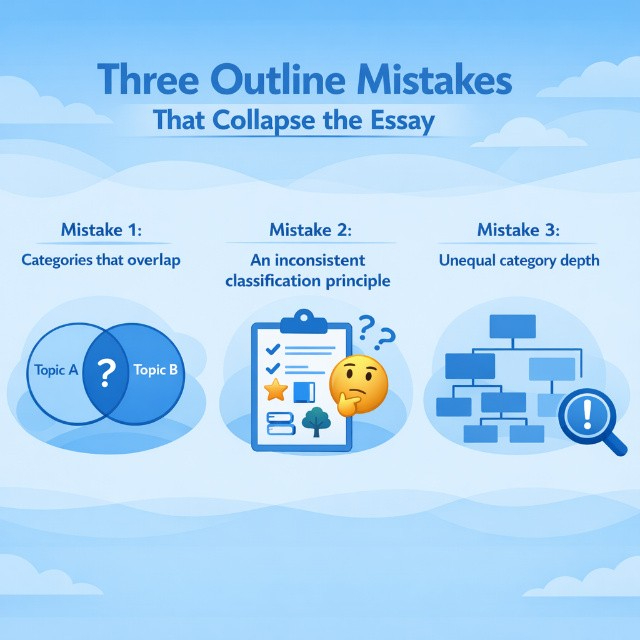
- Mistake 1: Categories that overlap. If a reader could assign the same example to two different categories, the categories aren't distinct. Test every example against every category definition. If there's any doubt about where something belongs, the category boundaries need tightening.
- Mistake 2: An inconsistent classification principle. Every category must flow from the same single criterion. Classifying dogs by size in paragraph one and by temperament in paragraph two is not a classification essay. It is a list of unrelated observations. Write your principle in one sentence before you write anything else, and hold every category to it.
- Mistake 3: Unequal category depth. If one body paragraph runs to six points and another to two, the essay feels lopsided even if the writing in each paragraph is strong. Your outline should show roughly equal weight across all three categories. If it doesn't, either deepen the thin category or trim the heavy one before you draft.
You've got the template, two worked examples, the length variations, and the common mistakes to avoid. The outline is done.
You've done the structural work. What's left is execution: three body paragraphs that each carry a category cleanly, transitions that connect them, and a conclusion that makes the classification feel like it mattered. If any of that is giving you trouble, CollegeEssay.org's classification essay team can take your outline and turn it into a finished essay. Tell us your topic, your categories, and your deadline. We handle the rest.
Frequently Asked Questions
What is a classification essay outline?
A classification essay outline is a structured plan that organizes your essay into an introduction, three body paragraphs (one per category), and a conclusion. It maps out your subject, your classification principle, and your categories before you start writing, so the essay has a clear logical structure from the first draft.
How do I write a classification essay outline for three categories?
Start by locking in your subject, your classification principle, and your three categories. Then fill in the standard five-paragraph structure: an introduction with a thesis that names all three categories, one body paragraph per category covering its definition, characteristics, and an example, and a conclusion that restates the thesis and summarizes each category.
What should a classification essay outline thesis statement include?
Your thesis should name the subject, the classification principle you are using, and all three categories. A reliable formula: [Subject] can be classified into three categories based on [principle]: [Category 1], [Category 2], and [Category 3]. If your thesis can't fit that structure loosely, your classification principle needs tightening first.
How long should a classification essay outline be?
The outline itself is typically one to two pages. The essay it produces depends on the assignment: 500 to 700 words for a short essay with one example per category, 800 to 1,200 words for a medium essay with two examples per category, and 1,500 words or more for a longer treatment with deeper analysis in each body paragraph.
Can I use the same classification essay outline for a division essay?
Yes, the structure is the same. The only difference is in the thesis: a classification essay thesis names a principle used to sort existing items into groups, while a division essay thesis identifies a whole and names the parts it breaks into. The body paragraph template, topic sentence, definition, characteristics, example, and transition apply to both.
Benjamin Cole Verified
Author
Dr. Benjamin Cole, holding a Ph.D. in English from Stanford, brings a decade of experience in academia and essay composition across a diverse range of writing forms. Specializing in expository and analytical writing, Benjamin has developed deep expertise in informative, classification, definition, exemplification, illustration, problem-solution, process analysis, synthesis, and extended essay formats. His comprehensive understanding of essay typology, from outlining, classification, and definition essays to selecting compelling topics for exemplification and synthesis essays, makes him a trusted authority in academic writing. Benjamin's ability to guide writers in identifying the right essay type and mastering its structure has earned him widespread recognition in essay education and expository writing methodology.
Specializes in:
types of essays
informative essay
classification essay
definition essay
exemplification essay
extended essay
illustration essay
problem solution essay
process analysis essay
synthesis essay
Read All Articles by Benjamin Cole
Keep Reading
Was This Blog Helpful?
On this Page