What Makes a Good Argumentative Essay Example?
A good argumentative essay example takes a clear, defensible position and supports it with evidence throughout every body paragraph.
Before you download any example below, check for three things:
- A thesis that makes a specific claim (not just a statement of topic)
- Body paragraphs that each address one point with evidence
- A conclusion that reinforces the argument rather than just summarizing it.
The three main models you will see across the examples are:
- The classical model (state your argument, support it, address counterarguments)
- The Rogerian model (acknowledge the opposing view, find common ground, then argue your position)
- The Toulmin model (claim, grounds, warrant, backing, qualifier, rebuttal).
Look for which model each example follows before you try to imitate it.
If you want a full breakdown of how each model works in practice, the argumentative essay guide covers structure and thesis construction in detail.
Short Argumentative Essay Examples
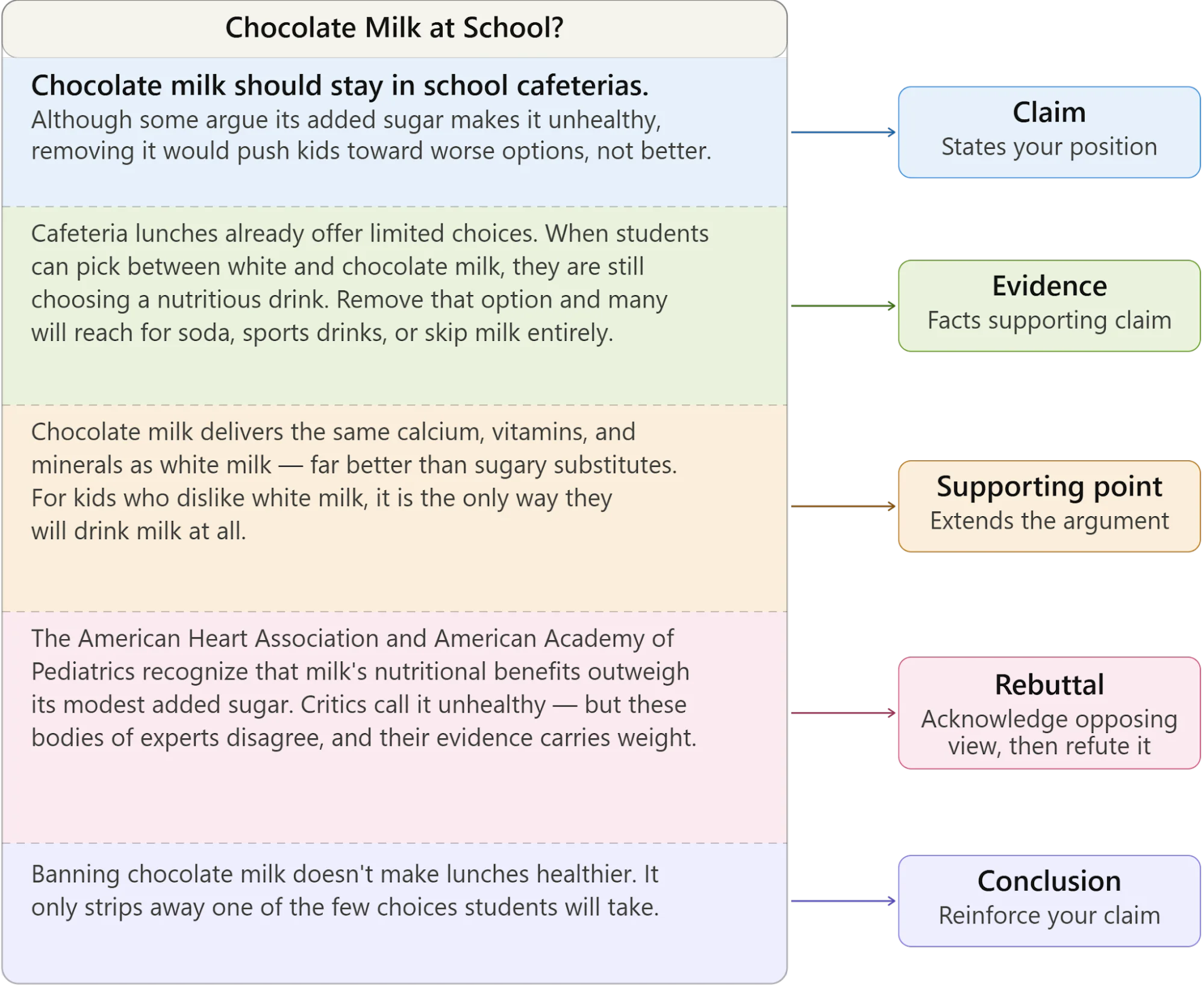
A short argumentative essay makes one focused argument in fewer paragraphs than the standard format and has no fixed word count minimum as long as it contains a clear claim and supporting evidence.
Short essays typically run two to three body paragraphs instead of the standard three, which means every sentence carries more weight.
The example below shows how to make a tight argument without padding it to meet a length requirement. If your assignment specifies a word count under 500 words, this format is the one to study.
Argumentative Essay Examples for University Students
University-level argumentative essays tackle broader, more complex topics and typically run longer than high school equivalents. Topics are rarely assigned at this level, so the examples below also demonstrate how to narrow a topic into a defensible thesis independently.
Argumentative Essay Examples for College
College argumentative essays require clear evidence and a well-structured argument, but the language should stay accessible. The examples below show how to support a claim convincingly without overly complex vocabulary.
Argumentative Essay Examples for High School
High school argumentative essays focus on building a structured argument with evidence and a clear counterargument section. The examples below cover the most common formats assigned at this level.
Argumentative Essay Examples for Middle School
Middle school argumentative essays keep the argument simple and focused, typically defending one clear position with two or three supporting points. The examples below show what a well-organized middle school essay looks like.
Argumentative Essay Examples for O Level
O level argumentative essays require strong command of written English and a formal structure. The examples below are written to the standard expected at Cambridge O level examinations.
Still not finding an example that matches what your professor is asking for? Tell us your grade level, topic, and assignment requirements, and our argumentative essay writing help team will match you with a writer who has written this type of essay before.
5-Paragraph Argumentative Essay Examples
A 5-paragraph argumentative essay follows a fixed structure: an introduction with a thesis statement, three body paragraphs each covering one supporting point, and a conclusion that restates the argument. This format is the most commonly assigned across all grade levels.
When you read the example below, pay attention to how the thesis is phrased.
A strong 5-paragraph thesis does two things: it states a position and signals the three supporting points that the body paragraphs will cover. If the thesis only states a position without signalling structure, the reader has no roadmap for what follows.
Also notice how the example handles the counterargument. Many students place it in the third body paragraph as a refutation. Others address it briefly in the introduction before stating the thesis. Both approaches are acceptable; what matters is that the counterargument is acknowledged and then answered, not just mentioned and dropped.
Argumentative Essay Examples for 6th Grade
6th grade argumentative essays are written to persuade a reader of a simple, specific position, usually on a topic the student has personal experience with. At this level, the main challenge is staying focused on one argument rather than shifting topics mid-essay.
The example below shows how to state a position clearly in the introduction, back it up with two or three reasons, and close without introducing new ideas.
Argumentative Essay Examples for 7th Grade
7th grade argumentative essays build on the 6th grade foundation by adding a more developed counterargument section. At this level, students are expected to acknowledge that a reasonable opposing view exists and then explain why their position is still stronger.
The example below demonstrates how to introduce a counterargument in its own paragraph without accidentally strengthening the other side. A common mistake at this level is stating the counterargument more convincingly than the rebuttal; the example shows how to avoid that.
Immigration Argumentative Essay Examples
Immigration is a frequently assigned topic for argumentative essays at high school and college level because it involves genuinely competing perspectives and a large body of available evidence.
Essays on this topic work best when the writer picks one specific aspect of immigration policy rather than trying to argue about the issue as a whole.
The examples below show two different positions argued effectively, and both demonstrate how to narrow a broad topic into a thesis specific enough to defend in a few paragraphs.
Pay attention to how each example sources its evidence: the strongest immigration essays cite specific legislation, statistics, or case studies rather than making general claims about how immigration affects society.
You have seen what a strong argumentative essay looks like across every grade level. Writing one from scratch is where most students get stuck: picking a position that holds up, building a counterargument that does not undercut your own thesis, and hitting a word count that actually satisfies the rubric. Share your topic and deadline, and get your argumentative essay written from scratch in as little as 24 hours.
How to Study an Argumentative Essay Example Before You Write Your Own
Four checks will tell you whether an argumentative essay example is worth imitating: thesis clarity, body paragraph structure, counterargument handling, and conclusion quality. Work through each one before you start writing your own essay.
First, identify the thesis statement. It should appear at the end of the introduction paragraph and make a specific, arguable claim. If you cannot find it, the essay has a structural problem you should not replicate.
Second, check whether each body paragraph has a clear topic sentence. The first sentence of each body paragraph should tell you exactly what point that paragraph proves. If it takes more than one sentence to understand what a paragraph is about, the paragraph structure is weak.
Third, look for the counterargument. A strong argumentative essay does not ignore opposing views. Find where the essay acknowledges a counterargument and how it responds to it. This is usually in one of the later body paragraphs or just before the conclusion.
Fourth, read the conclusion to see whether it restates the thesis or just summarizes the content. Restating the thesis with a new language is correct. Introducing a new idea in the conclusion is a structural error.
You have examples for every grade level and format. The next step is writing an essay that actually holds up under your professor’s rubric. Give us your topic, length, and deadline, and get a custom argumentative essay written by CollegeEssay.org to your exact requirements.
Frequently Asked Questions

 (1))
 (1))