Annotated Bibliography Topics: 255 Ideas Sorted by Subject and Difficulty
The most researchable annotated bibliography topics are tied to active academic debates. Social media and mental health, racial disparities in healthcare, climate change policy, and addiction psychology all have deep peer-reviewed literature in standard library databases. The sections below cover 18 disciplines. Each opens with the topic types that have the deepest literature base in that field.
Good Annotated Bibliography Topics
Good annotated bibliography topics combine a debatable central question with an active peer-reviewed literature base. The subjects below consistently return 20+ credible academic sources across disciplines and work across undergraduate assignment lengths.
- The gender pay gap in STEM fields: structural causes, measurement debates, and policy responses
- The relationship between neighborhood green space and mental health outcomes in urban populations
- How parental incarceration affects children’s educational attainment and behavioral development
- The ethics of genetic privacy: what direct-to-consumer DNA testing reveals and who owns the data
- Media framing of climate change and its effect on public risk perception
- The long-term outcomes of bilingual education versus English immersion for immigrant children
- How social isolation in elderly populations affects cognitive decline and mortality risk
- Criminal justice reform: the evidence on whether incarceration reduces recidivism
- The relationship between arts education and academic performance in K–12 students
- Paid family leave policy: comparative outcomes across countries and industries
- The ethics of organ donation systems: opt-in versus opt-out frameworks and donation rates
- How childhood poverty affects brain development and long-term health outcomes
- The effectiveness of community policing models in reducing violent crime
- Digital privacy legislation: what GDPR accomplished and what U.S. policy lacks
- The relationship between housing affordability and workforce participation in major metropolitan areas
Annotated Bibliography Topics Topics for Nursing
The strongest annotated bibliography topics for nursing assignments are those with an active peer-reviewed literature base in clinical outcome research. Nurse-to-patient ratios, burnout in emergency settings, and evidence-based practice adoption all have extensive coverage in PubMed and nursing-specific journals.
- The impact of nurse-to-patient ratios on patient safety outcomes
- Burnout and mental health among emergency department nurses
- Evidence-based practice adoption in clinical nursing settings
- Cultural competency training and its effect on patient care quality
- The role of nurses in chronic disease management and patient education
- Technology integration in nursing: electronic health records and beyond
- Moral distress in nursing and its relationship to staff retention
- Nursing leadership styles and their effect on unit-level outcomes
- The influence of nursing on public health policy
- Telehealth nursing: scope, effectiveness, and ethical considerations
- The shortage of nurses: causes, projections, and policy responses
- Pain management practices in nursing and the risk of opioid dependence
- Simulation-based training in nursing education and its effect on clinical competency
- Delegation and scope of practice: how nurses navigate task assignment in high-acuity settings
- The effect of 12-hour nursing shifts on patient safety and nurse wellbeing
Annotated Bibliography Topics Topics for Psychology
The most citable annotated bibliography topics in psychology are those with decades of empirical research behind them. Childhood adversity and adult mental health, CBT versus medication for depression, and the psychology of implicit bias all have meta-analyses and longitudinal studies available in major psychology databases.
- The relationship between childhood adversity and adult mental health outcomes
- Cognitive behavioral therapy versus medication for treatment-resistant depression
- Social media use and body image dissatisfaction in adolescents
- The psychology of implicit bias and its effect on decision-making
- Sleep deprivation and its cognitive and emotional consequences
- Attachment theory and adult romantic relationship patterns
- The placebo effect: mechanisms and clinical implications
- Trauma-informed care approaches in mental health settings
- The role of exercise in depression and anxiety treatment
- Psychological factors that predict academic success in college students
- The psychology of loneliness and its effects on physical and mental health
- Bystander intervention: why people help or don’t in emergencies
- The effect of mindfulness-based interventions on chronic pain management
- How grief is processed differently across cultures and what that means for clinical practice
- The psychology of radicalization: pathways into and out of extremist beliefs
Annotated Bibliography Topics for Sports
The best annotated bibliography topics in sports cover areas where policy, health, and social science intersect. Concussion research, Title IX outcomes, and athlete compensation in college athletics all have substantial peer-reviewed literature in journals like the Journal of Sport and Health Science and the Journal of Sports Economics.
- The long-term neurological effects of concussions in contact sports
- How Title IX changed women’s participation in collegiate athletics
- The role of sports psychology in elite athlete performance
- Performance-enhancing drug policy in international Olympic competition
- Youth sports specialization and its effect on injury rates
- The economics of college athletics and student-athlete compensation
- Race and representation in professional sports coaching and leadership
- How sports fandom affects mental health and community identity
- The evolution of sports broadcasting and fan engagement
- Gender pay disparity in professional tennis and other co-gendered sports
- The role of social media in athlete branding and fan relationships
- Youth participation trends in team sports and the barriers to access
- Athlete activism: the history, reception, and consequences of political speech in sport
- The physical and psychological demands of referee and officiating roles
- Sports betting legalization: economic outcomes, problem gambling rates, and regulatory responses
Annotated Bibliography Topics in Healthcare
The best annotated bibliography topics in healthcare are those tied to active policy debates. Racial disparities in access to care, vaccine hesitancy, antibiotic resistance, and the opioid epidemic all have substantial literature spanning clinical journals, health policy research, and government data.
- Health disparities in access to care among low-income and minority populations
- The Affordable Care Act’s measurable impact on the uninsured rate
- Physician burnout and its relationship to patient safety events
- Antibiotic resistance: causes, consequences, and public health response
- Mental health integration in primary care settings
- The opioid epidemic: prescribing patterns, policy responses, and outcomes
- Telehealth expansion post-pandemic: access, equity, and limitations
- Vaccine hesitancy: drivers, communication strategies, and public health impact
- The role of community health workers in underserved populations
- End-of-life care decision-making and the ethics of palliative medicine
- Electronic health records: implementation challenges and patient safety implications
- The relationship between food deserts and chronic disease rates in urban populations
- Maternal mortality in the United States: trends, disparities, and systemic causes
- The mental health consequences of the COVID-19 pandemic on healthcare workers
- Preventive care utilization gaps: why patients skip screenings and what changes that
Annotated Bibliography Topics for History
The strongest history annotated bibliography topics are those with a long historiography covering both foundational scholarship and recent revisionist work. Reconstruction’s collapse, the internment of Japanese Americans, and the Marshall Plan all have primary sources and decades of academic debate available.
- The causes and long-term consequences of the Reconstruction era’s collapse
- Women’s suffrage: the arguments, strategies, and opposition
- The role of propaganda in mobilizing civilian support during World War II
- The economic and social consequences of the transatlantic slave trade
- Cold War nuclear deterrence policy and the logic of mutual assured destruction
- The civil rights movement’s legislative milestones and their limits
- Colonialism’s lasting influence on political instability in post-colonial states
- The causes of the Great Depression and the effectiveness of New Deal responses
- Immigration policy in the United States from 1880 to 1924
- The role of religion in shaping early American political and social institutions
- The internment of Japanese Americans during World War II: policy, resistance, and redress
- The suffragette movement in Britain: tactics, opposition, and long-term legacy
- The Marshall Plan: design, implementation, and its effect on postwar European recovery
- The Vietnam War and its effect on American domestic politics and public trust in government
- The Holocaust: historiographical debates, perpetrator motivations, and bystander responses
Annotated Bibliography Topics for Biology
The best biology annotated bibliography topics are those with active research and ongoing scientific debate. CRISPR gene editing, the gut microbiome and immune function, and antibiotic resistance mechanisms all return extensive peer-reviewed results on PubMed and Google Scholar.
- CRISPR gene editing: applications, ethical questions, and regulatory challenges
- The role of the gut microbiome in immune system function
- Antibiotic resistance mechanisms and the pipeline problem in drug development
- Climate change and its documented effects on species migration and extinction
- The biology of aging: telomere shortening, senescence, and longevity research
- Epigenetics: how environment shapes gene expression without altering DNA
- Vaccine development and the immunological principles behind mRNA technology
- The relationship between chronic inflammation and disease
- Biodiversity loss: causes, ecosystem consequences, and conservation strategies
- The science of sleep: circadian rhythms, memory consolidation, and health
- Microplastics in the food chain: what the current research shows about human health risk
- The role of stem cell research in regenerative medicine
- Invasive species: ecological impact, management strategies, and policy responses
- The neuroscience of addiction: how repeated substance use reshapes brain structure and function
- Ocean acidification: mechanisms, marine ecosystem effects, and projected timelines
Annotated Bibliography Topics for Technology
The most citable technology annotated bibliography topics sit at the intersection of policy, ethics, and empirical research. Algorithmic bias in AI systems, facial recognition regulation, and misinformation spread on social media all have literature in both technical journals and social science research.
- Algorithmic bias in artificial intelligence systems and its real-world consequences
- The privacy implications of large-scale data collection by tech platforms
- Cybersecurity threats in critical infrastructure and national security
- Social media platform design and its documented effect on user behavior
- The digital divide: barriers to technology access and their economic consequences
- Autonomous vehicle technology: progress, liability questions, and regulation
- The environmental cost of data centers and cryptocurrency mining
- Misinformation spread on social media: mechanisms, scale, and countermeasures
- Remote work technology and its effect on productivity and work-life balance
- Artificial intelligence in healthcare: diagnostic tools, ethics, and patient trust
- The regulation of facial recognition technology: civil liberties, accuracy, and policy
- Children and screen time: what the developmental research actually concludes
- Open-source software: economic model, security implications, and community governance
- Deepfakes: technical capabilities, detection methods, and the threat to information integrity
- The ethics of predictive policing algorithms: accuracy, racial bias, and accountability
Annotated Bibliography Topics for Sociology
The strongest sociology annotated bibliography topics are those with an established empirical literature base in major journals. Gentrification and displacement, mass incarceration’s community effects, and structural racism in housing markets all have deep coverage in the American Sociological Review and Social Forces.
- Gentrification and its displacement effects on working-class urban communities
- The relationship between income inequality and political participation
- Social media’s effect on social capital and community cohesion
- Gender dynamics in domestic labor and their relationship to workforce participation
- The sociology of mass incarceration and its community-level consequences
- How immigration shapes cultural identity in second-generation Americans
- Celebrity culture and its influence on consumer values and aspirations
- The role of faith communities in meeting social welfare needs
- Structural racism in housing markets: redlining’s legacy and present effects
- How social class shapes educational expectations and academic outcomes
- The sociology of online dating: mate selection, identity presentation, and relationship outcomes
- Collective action and social movements: what determines whether protest produces change
- The sociology of mental illness stigma and its effect on help-seeking behavior
- How suburbanization reshaped American class segregation and civic life
- The sociology of work and automation: how technological displacement affects identity and community
Annotated Bibliography Topics for English
The best English annotated bibliography topics have both primary texts and substantial secondary criticism. The Harlem Renaissance’s influence on American literature, feminist literary criticism and the Western canon, and dystopian fiction as political commentary all meet that standard with peer-reviewed literary scholarship available in JSTOR and MLA International Bibliography.
- The representation of gender in Victorian literature and its cultural context
- Postcolonial identity and language in the works of Chinua Achebe
- The influence of the Harlem Renaissance on American literary tradition
- Dystopian fiction as political commentary: Orwell, Huxley, and contemporary examples
- The oral tradition and its influence on contemporary African American literature
- Shakespeare’s portrayal of power and its relevance to modern political discourse
- Modernism and the fragmented self in twentieth-century fiction
- The censorship of literature in schools: arguments, cases, and consequences
- Feminist literary criticism and the rereading of the Western canon
- How translation shapes the reception of world literature in English-speaking markets
- Ecocriticism and the representation of nature in American literature
- Young adult fiction and its role in shaping adolescent identity and values
- Trauma narrative in contemporary memoir: how writers shape and communicate lived suffering
- The gothic tradition in American literature and what it reveals about cultural anxiety
- Narrative medicine: how storytelling in clinical and literary contexts shapes patient care
Annotated Bibliography Topics for Business
The strongest business annotated bibliography topics connect empirical research to real organizational outcomes. Corporate social responsibility and greenwashing, diversity and inclusion program effectiveness, and the gig economy’s effect on worker rights all have peer-reviewed literature in business and economics journals.
- Corporate social responsibility: stakeholder pressure, genuine commitment, and greenwashing
- The psychology of consumer decision-making and its marketing applications
- Diversity and inclusion initiatives in corporate settings: outcomes and measurement
- The economic effects of mergers and acquisitions on employees and communities
- Remote work policy and its effect on organizational culture and productivity
- Ethical failures in financial institutions: causes, consequences, and regulatory response
- Small business survival rates and the factors that predict long-term viability
- Supply chain vulnerabilities exposed by the COVID-19 pandemic
- The gig economy: worker classification, benefits access, and labor rights
- Entrepreneurship and innovation in emerging market economies
- The business case for sustainability: how environmental strategy affects long-term firm value
- Negotiation and gender: how gender affects outcomes in salary and contract negotiations
- Platform monopolies: antitrust frameworks and the challenge of regulating big tech
- The psychology of pricing: how framing, anchoring, and scarcity shape purchasing decisions
- Corporate whistleblowing: legal protections, organizational retaliation, and ethical frameworks
Annotated Bibliography Topics for Education
The best education annotated bibliography topics have a well-established empirical base. The achievement gap and its systemic causes, the effectiveness of early childhood intervention, and school funding inequality all have decades of longitudinal research in the American Educational Research Journal and Harvard Educational Review.
- The achievement gap between low-income and high-income students: causes, persistence, and policy responses
- The effectiveness of bilingual education programs compared to English-only instruction for ELL students
- How teacher expectations shape student performance: the Pygmalion effect in K–12 classrooms
- Standardized testing and its effect on curriculum, teaching practice, and student outcomes
- The impact of class size reduction on student achievement in elementary schools
- Charter schools versus traditional public schools: what the comparative evidence shows
- The role of early childhood education programs in closing the opportunity gap
- School funding inequality: how property-tax-based funding creates and sustains educational disparities
- The effect of trauma and adverse childhood experiences on learning and school performance
- Inclusive education for students with disabilities: evidence on outcomes in mainstream versus separate settings
- The impact of summer learning loss on the achievement gap and how schools address it
- How homework policies affect student learning outcomes and family stress levels
Persuasive Annotated Bibliography Topics
The best persuasive annotated bibliography topics are those where peer-reviewed scholars actively disagree, minimum wage and unemployment, affirmative action in college admissions, and capital punishment's deterrence effect all have substantial evidence on multiple sides, which is exactly what annotations on a persuasive paper need to represent.
- Whether a federal minimum wage increase reduces or increases unemployment
- The case for and against universal basic income
- Capital punishment: the evidence on deterrence and wrongful conviction rates
- Whether affirmative action in college admissions advances or undermines equity
- The arguments for and against legalizing recreational marijuana at the federal level
- Universal healthcare: comparative evidence from systems in other countries
- The ethics and effectiveness of animal testing in medical research
- Whether social media companies should be held liable for harmful content
- The evidence on whether stricter gun control legislation reduces gun violence
- College tuition and student debt: the case for and against free public university
- Immigration policy: the evidence on economic and social effects of stricter border enforcement
- Nuclear energy as a climate solution: the case for and against expansion
Critical Annotated Bibliography Topics
Strong critical annotated bibliography topics are those that examine underlying assumptions and power structures rather than simply arguing a position, critical race theory in American legal history, the white savior narrative in development aid, and surveillance capitalism all have established critical frameworks with peer-reviewed scholarship that lends itself to evaluative annotations.
- Critical race theory and how it applies to the study of American legal history
- Media representation of mental illness and its effect on public stigma
- Feminist critiques of the beauty and diet industry
- How postmodern theory challenged the idea of objective historical narrative
- The portrayal of immigration and immigrants in American political media
- Capitalism’s relationship to environmental degradation: critical perspectives
- Queer theory and its influence on literary and cultural studies
- The myth of meritocracy and its function in maintaining class inequality
- Surveillance capitalism: what is being collected, who profits, and at what cost
- Critical analysis of nonprofit industrial complex critiques in social justice literature
- The white savior narrative in international development and humanitarian aid discourse
- Disability studies and the social model: how framing shapes policy and lived experience
Fun Annotated Bibliography Topics
The most researchable fun annotated bibliography topics are those with genuine peer-reviewed literature in psychology, sociology, or cultural studies. The psychology of humor, how video game design uses behavioral psychology, and why people believe conspiracy theories all have academic sources and make for more engaging annotations than a standard topic.
- The psychology of humor: why humans laugh and what it signals socially
- The history and cultural significance of competitive eating
- How video game design uses behavioral psychology to drive engagement
- The science of taste and smell: why food preferences vary across cultures
- Urban legends and folklore: what they reveal about cultural anxieties
- The sociology of fan communities and collective identity
- The psychology of superstition and magical thinking in everyday behavior
- How music affects mood, cognition, and physical performance
- The history of board games and their role in social bonding
- The science behind why certain smells trigger powerful memories
- The anthropology of gift-giving: what exchanges reveal about social relationships
- Why people believe in conspiracy theories: psychological and sociological explanations
Easy Annotated Bibliography Topics
The easiest annotated bibliography topics are those with a large, accessible peer-reviewed literature base and a clear empirical question. The health effects of regular exercise, social media and teen mental health, sleep deprivation in college students, and the environmental impact of plastic pollution all have dozens of credible academic sources available through Google Scholar and standard library databases.
- The documented health effects of regular physical exercise
- Social media and mental health in teenagers: what the research actually shows
- The causes and environmental consequences of plastic pollution in oceans
- Sleep deprivation: health consequences and common causes in college students
- The benefits and risks of a plant-based diet
- How stress affects the immune system
- The effectiveness of mindfulness meditation for anxiety reduction
- Screen time and child development: what current research concludes
- The environmental and economic case for renewable energy
- The relationship between financial literacy and personal financial outcomes
- The health effects of air pollution in urban environments: what the research shows
- How volunteering affects mental health and wellbeing in adults
You've got a topic, probably one of the easier ones, which is a smart call. Easy topics have plenty of sources, but finding the ones that are actually peer-reviewed, summarising each one accurately, and writing evaluations that go beyond "this source is relevant" is still where most students lose points.
If you'd rather hand that part off, get annotated bibliography writing assistance. Give us your topic, how many sources you need, and your citation format, and you'll have a complete bibliography back within 24 hours.
Annotated Bibliography Topics for College Students
The best annotated bibliography topics for college students are those complex enough to require academic sources but focused enough for a typical undergraduate bibliography. Student loan debt and financial outcomes, food insecurity on campus, and the relationship between sleep quality and academic performance are all directly relevant to college life and well-covered in peer-reviewed research.
- Student loan debt and its long-term effect on financial planning and life decisions
- The relationship between sleep quality and academic performance in undergraduates
- Food insecurity on college campuses: scale, causes, and institutional responses
- The effectiveness of college mental health services and barriers to student utilization
- First-generation college students: challenges, support gaps, and outcomes
- Academic dishonesty and the conditions that make it more likely
- The effect of part-time employment on academic performance and graduation rates
- Diversity in college admissions: the evidence on outcomes for students and institutions
- The ROI of a college degree: how the calculus varies by major, institution, and student background
- Alcohol and substance use on college campuses: prevalence, risk factors, and prevention programs
- The effect of college Greek life membership on academic performance and social development
- Racial and ethnic minority student experiences of belonging and exclusion on predominantly white campuses
- The mental health impact of social comparison and social media use in college students
- Gap year outcomes: how taking time between high school and college affects academic and career trajectories.
Annotated Bibliography Topics for Research Papers
The strongest annotated bibliography topics for research-focused assignments are those with a deep base of empirical studies and meta-analyses. The neurobiological mechanisms of addiction, implicit bias in medical diagnosis, and racial disparities in maternal mortality all have systematic reviews and longitudinal research that meet the expectations of a research-level bibliography.
- The neurobiological mechanisms of addiction and their implications for treatment
- Early childhood intervention programs and their long-term economic and social returns
- The effectiveness of restorative justice programs compared to traditional sentencing
- Implicit bias in medical diagnosis and its effect on health outcomes for minority patients
- Longitudinal effects of poverty on cognitive development in children
- Climate change and mental health: the emerging research on eco-anxiety and displacement trauma
- The science of habit formation and behavior change
- Misinformation and belief: why people accept false information and what changes minds
- The effects of income inequality on social mobility across generations
- Racial disparities in maternal mortality in the United States: causes and systemic factors
- The effectiveness of cognitive behavioral therapy for post-traumatic stress disorder in veterans
- School-to-prison pipeline: how disciplinary policies in K–12 schools shape long-term incarceration rates
- The long-term health consequences of childhood obesity: a longitudinal research review
- How neighborhood-level poverty affects educational attainment independent of family income
- The effectiveness of needle exchange programs in reducing HIV transmission and drug-related harm
What Makes a Good Annotated Bibliography Topic?
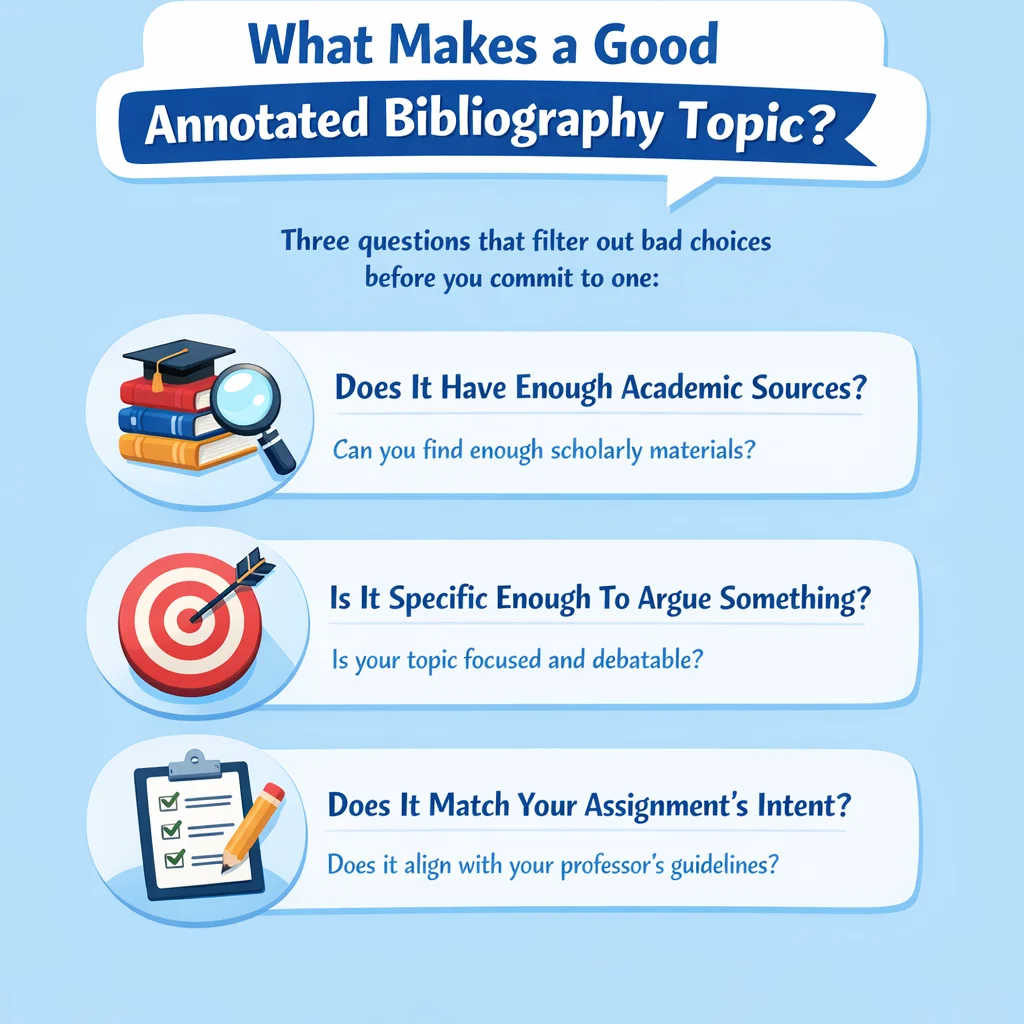
Three questions that filter out bad choices before you commit to one:
-
Does it have enough academic sources?Your topic needs as many credible, peer-reviewed sources as your assignment requires, ideally, a few extras in case some don't hold up on closer reading. Do a quick search on Google Scholar or your library database before you commit. If you can't find at least double your required source count in 10 minutes, the topic is too narrow or too specialized.
-
Is it specific enough to argue something?“Mental health” is not a topic — it’s a category. “The relationship between social media use and depression in adolescents” is a topic. Specificity makes your annotations sharper and your bibliography more coherent. If you’re not sure how to narrow your topic, look at what the researchers in your preliminary source search are actually arguing — that’s usually where the real debates are.CollegeEssay.org’s annotated bibliography writers review topic submissions from students across more than 40 disciplines; the topics that consistently have sufficient peer-reviewed sources are those tied to ongoing policy debates or active research fields, not historical events with a fixed literature base.
-
Does it match your assignment’s intent?A bibliography for a persuasive paper needs sources that take positions. One for a research paper needs empirical studies. One for a literature review needs a mix of foundational and recent scholarship. Make sure your topic generates the type of sources your assignment requires, not just sources about your topic in general. If you are unsure what a correctly written annotation look like check complete guide on how to write annotated bibliography.
With your topic selected, getting annotated bibliography writing help for any topic can save you hours of research and prevent common mistakes. Locating peer-reviewed sources, analyzing them thoroughly, and writing accurate summaries with critical evaluation is where many students underestimate the workload and lose marks.
Submit your topic, required sources, citation style, and deadline, and our experts will deliver a complete, properly formatted annotated bibliography, often within 24 hours.
Frequently Asked Questions

Get expert writing help.
- Expert writers in your subject
- 100% human-written work
- From $11 per page
Price shown before checkout.
Now you need sources and annotations.
Tell us your topic, source count, and citation format. Complete bibliography back in 24 hours.
See how it works