What Does a Complete PhD Essay Look Like From Introduction to Conclusion?
A complete PhD essay demonstrates how introduction, body, and conclusion work together as a single argument. The introduction states a position, the body develops and defends it through structured analysis, and the conclusion draws the argument to a specific claim rather than a general summary.
The example below covers an analytical topic at PhD level and shows how each section connects to the next.
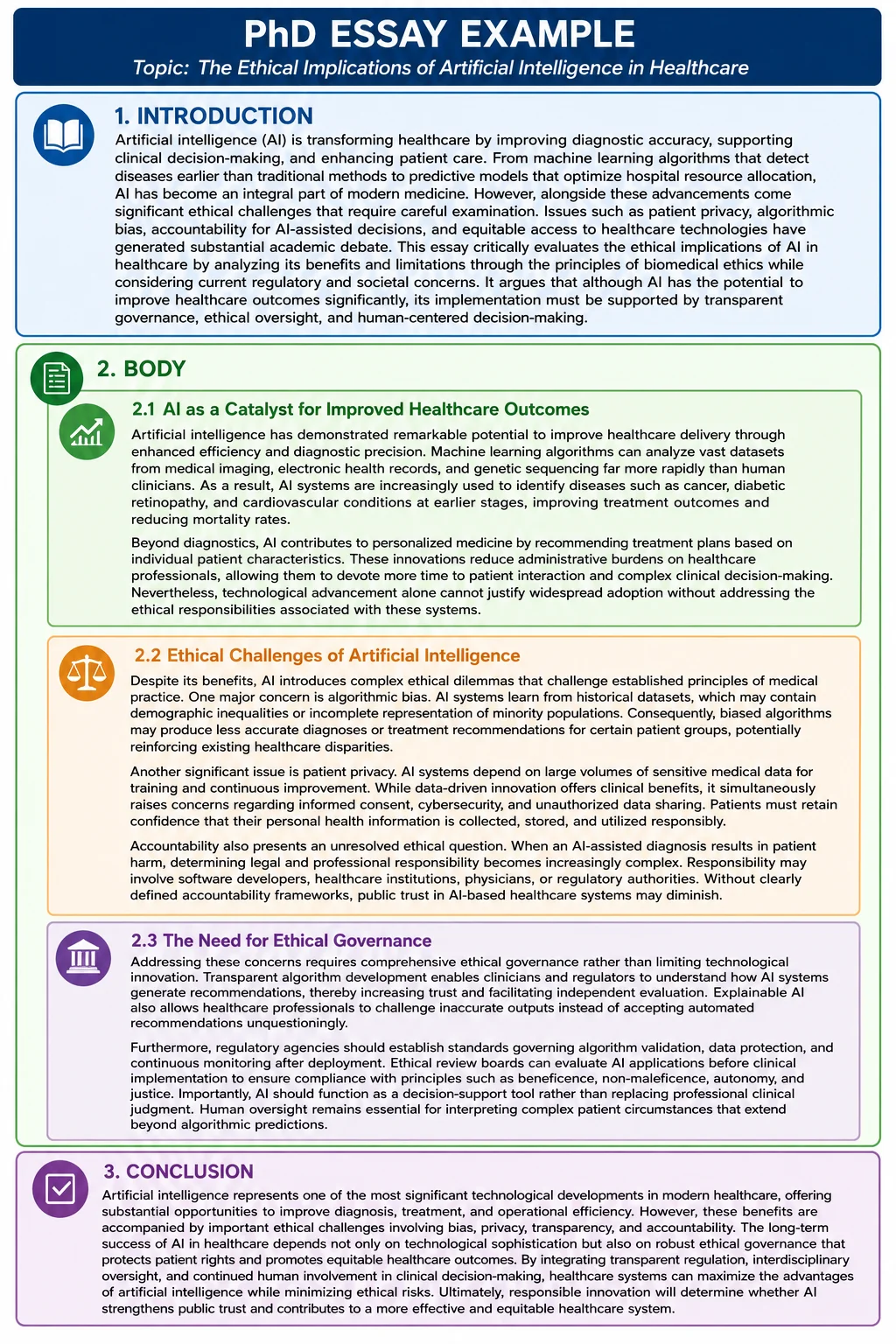
1Topic: The Ethical Implications of Artificial Intelligence in Healthcare
What this Example Does
- The introduction above states the essay’s position in the final sentence rather than opening with it, which is the correct structure for a critical evaluation essay.
- The body develops three distinct strands: the benefits of AI in diagnostics and personalized medicine, the ethical challenges of bias, privacy, and accountability, and the governance frameworks needed to address those challenges.
- The conclusion restates the argument with specificity, naming transparent regulation and interdisciplinary oversight as the mechanisms that determine whether AI contributes positively to healthcare equity.
What Do Strong PhD Personal Statement Examples Look Like?
A PhD personal statement must establish why you are drawn to research specifically and name the question or problem that pulled you in, both within the opening paragraph.
The two examples below cover a STEM field and a social science field. Both follow the same structural pattern: a specific moment in a named lab, a precisely stated research question, a named advisor at the target program, and a closing paragraph that states a trajectory rather than an aspiration.
Example 1Molecular Biology
This example opens in a lab at a specific moment and names the PI, the technique, and the unexpected result within the first paragraph. The research question is stated precisely in paragraph two.
The choice of a doctoral program over industry or a master’s degree is argued explicitly. The closing paragraph names a research trajectory, not a general statement of interest in science.
Example 2Clinical Psychology
This example opens with a clinical observation from a named research assistant role rather than a personal history. The transition from observation to research question to methodological approach happens across the first two paragraphs.
The distinction between a PhD research identity and a clinical practitioner identity is made explicitly, which is the structural move this program type requires.
If you are still working out what research question to center your essay around, the guide to PhD essay topics covers research question selection by discipline and program type.
These examples demonstrate the overall structure of a strong doctoral application essay, but the real challenge lies in making it your own. You need to identify a defining experience, develop a research-focused narrative grounded in your academic or laboratory work, and conclude with future goals that reflect your unique journey rather than simply echoing sample essays. If you need additional support, explore our essay writing services by type, including specialized assistance for PhD and MD/PhD application essays from writers experienced in crafting doctoral admissions documents.
What Do MD-PhD Essay Examples Look Like?
Strong MD-PhD essay examples open with a specific clinical observation that generates a research question the applicant could not answer without both degrees.
The AMCAS MD/PhD essay has one job: answer the question “Why do you need both degrees?” The answer is not “because I love patients and I love science.”
It is a specific account of a clinical observation that generated a research question requiring PhD-level methodology to answer, and an argument for why treating the patients who carry that question requires clinical training as well.
Example 1Oncology
This example opens with a specific patient encounter in a named clinic with a named attending physician. The research question emerges directly from the clinical observation rather than being stated as a pre-existing interest. The “why both degrees” argument is made in a single explicit paragraph, which is the move most applicants omit or bury.
Example 2Neuroscience
This example uses the “unanswered clinical question” structure rather than the more common “personal inspiration” structure. The research question is named in paragraph one. The necessity of both degrees is argued from evidence: what clinical training cannot provide, and what a PhD alone cannot accomplish.
Common failure modes to avoid
- Listing research experiences and clinical experiences in parallel without connecting them to a single question
- Opening with a childhood memory rather than a clinical or research moment
- Stating the clinician-scientist identity as an aspiration rather than demonstrating the observation that generated it
- Making the “why both” argument implicitly and expecting the admissions reader to infer it
What Does a Significant Research Experience Essay Look Like?
The AMCAS significant research experience essay is the most technically demanding PhD application document: it requires naming specific techniques, quantifying your contribution, and connecting bench work to a clinical outcome, all within a 10,000-character limit.
Most applicants write this essay as a chronological account of their lab work. The strongest versions have a narrative arc: they move from early dependence on supervision toward independent experimental design, and end with a moment where the applicant saw bench research connect to a patient outcome.
Example 1Biochemistry and Cell Biology
This example opens with the research question the lab studies, then places the applicant’s specific project within it. The troubleshooting passage names the exact variable causing inconsistency, demonstrating the level of technical depth the essay requires. The closing connects the biochemistry to a named disease mechanism.
Example 2Biomedical Engineering
This example covers two distinct lab experiences with a clear transition between them. Each experience names specific instruments and computational methods.
The validation metrics are quantified rather than described vaguely. The final paragraph connects the engineering work to a specific patient outcome the applicant observed directly.
Structure of a high-scoring significant research essay
- Open with the research question your lab studies, then place your specific project within it
- Name the PI, institution, and timeframe for each experience
- Name two to three specific techniques per experience, not a full inventory
- Describe one result that surprised you or required troubleshooting, and explain what you did
- Include one sentence linking your bench work to a patient population or clinical outcome
- Name specific fellowships, symposia, or publications where external reviewers validated your contribution
CollegeEssay.org’s writers review significant research experience essays across biochemistry, biomedical engineering, and clinical psychology and flag missing technique names and absent clinical connections as the two most common structural gaps.
What Do PhD Essay Examples Look Like for Non-Medical Graduate Programs?
Graduate school PhD essays outside medicine focus on a single research question rather than a dual clinical-research identity, and the opening must establish the intellectual problem before introducing the applicant.
Example 1Humanities PhD, History
This example leads with an explicit thesis about the existing historiography in sentence one and states the counter-argument in sentence two. The archival sources are named in the first paragraph.
Faculty fit is addressed with a specific explanation of why that scholar’s published work matters for the project, not a general statement of admiration.
Example 2STEM PhD, Computer Science
This example opens with the research problem rather than the applicant’s background. The specific research question and a preliminary quantified finding appear by the end of the first paragraph. The advisor fit is explained through a single specific claim about how that researcher’s work intersects with the applicant’s project.
Key structural difference from AMCAS essays
Non-medical PhD statements of purpose lead with the intellectual argument. There is no narrative scene, no attending physician, and no childhood memory.
The first paragraph must contain the thesis, the method, and a signal that the applicant is already inside the research. Personal motivation, if included at all, appears after the intellectual case has been made.
What Opening Patterns Appear in Successful PhD Essay Examples?
The four opening patterns that appear most often in successful PhD essays are the specific lab moment, the unanswered research question, the named field-level problem, and the clinical observation.
Four openings appear repeatedly in successful PhD essays:
1The Specific Moment
Opens in media res: a named lab, a failed experiment, a patient encounter, a dataset result that did not match the prediction. Gets the reader into the science immediately. This is the most common opening in successful MD/PhD personal statements and STEM PhD applications.
2The Unanswered Question
Opens with a precise research question and signals immediately that the applicant has been working toward it. “What makes some neurons resistant to the protein aggregation that drives Alzheimer’s disease? I have spent three years in Dr. Yuen’s lab working toward the answer.” Works well for STEM PhD personal statements.
3The Named Problem
Opens with a field-level problem and places the applicant inside it. More common in humanities and social science PhD essays. Effective when the research question is genuinely original to the applicant’s framing.
4The Clinical Observation
Opens with a specific patient encounter or clinical pattern that generated a question the applicant could not stop pursuing. The canonical MD/PhD opening. Fails when the clinical detail is vague or the transition to the research question is absent.
What does not work
- “I have always been fascinated by...” (every admissions reader has encountered this hundreds of times)
- Childhood memories that take more than one sentence to connect to a research question
- Opening with a quotation from a prominent scientist
- Defining a term (“Research is defined as...”)
Pro Tip: A PhD essay that opens without a named lab or a specific research question will lose the reader before the second paragraph. CollegeEssay.org provides PhD and MD/PhD application essay support from writers who specialize in doctoral admissions documents.
What Do Strong PhD Essay Introductions Look Like?
Strong PhD essay introductions place the reader inside the research before the first paragraph ends by naming a lab, a result, or a precise research question.
The four examples below each use a different opening move. Study which one matches your situation before writing your own.
Introduction 1The Lab Moment (STEM)
This opening names a lab, establishes the applicant’s independence, introduces a specific scientific contradiction, and creates forward pull without over-explaining. The reader is inside the research in sentence one and wants to keep reading by sentence three.
Introduction 2The Clinical Observation (MD/PhD)
This opening places a specific clinical moment first, names the physician, and transitions directly to a research question in the final sentence. The “I was a third-year undergraduate” detail grounds the timeline without being the focus of the paragraph.
Introduction 3The Intellectual Problem (Humanities/Social Sciences)
This opening presents a counter-argument to the existing literature in sentence two. It does not introduce the applicant by name or background. The intellectual position is the subject of the paragraph, which is the correct approach for programs where research contribution matters more than personal narrative.
Introduction 4The Dataset Finding (Quantitative Social Sciences)
This opening leads with a specific empirical finding, names the dataset size, and identifies the finding as surprising relative to existing predictions. The applicant’s role appears late in the paragraph, after the finding has already established why this person’s work matters.
By this point, you’ve explored the major types of PhD application essays along with several effective introduction and conclusion approaches. Understanding the structure is an important first step, but transforming your own research experience, laboratory work, clinical observations, and academic goals into a compelling admissions essay is a far more demanding task. If you need personalized guidance, our professional writing service for every essay type covers specialized support for PhD and MD/PhD application documents. Our writers work from your unique experiences and research background to create a tailored essay rather than relying on generic templates.
How Do Strong PhD Application Essays End?
Strong PhD application essays end by naming a specific research trajectory, a translational goal with a defined endpoint, or an explicit restatement of why both degrees are required.
Strong closings do one of four things: name a specific research trajectory, state a translational goal with a defined endpoint, name an institutional connection the applicant intends to develop, or make the “why both degrees” argument explicit for the final time. The four examples below demonstrate each.
Closing 1Named Research Trajectory (STEM PhD)
This closing names a specific research direction, a specific methodology, a specific institutional resource, and a timeline. It also returns to the opening image of the western blot, which creates structural closure without being sentimental.
Closing 2Clinician-Scientist Commitment (MD/PhD)
This closing names a specific future clinical scenario rather than a general aspiration. It restates the “why both degrees” argument in concrete terms and closes with a commitment rather than a hope.
Closing 3Policy and Translational Goal (Applied fields)
This closing specifies a deliverable (a validated protocol), a mechanism (clinical trials), and a defined career structure. It ends with a statement about the training environment, which is a direct signal to the admissions committee about what the applicant is looking for and why this program specifically.
Closing 4Field Contribution With Institutional Fit (Humanities PhD)
This closing names a specific scholarly and policy contribution, a type of institutional position, a teaching commitment, and a direct statement of program fit. The final sentence is confident without being generic.
What Makes a Strong PhD Application Essay?
The strongest PhD application essays open with a specific scene, name a concrete research question within the first two sentences, and establish the applicant’s scholarly identity before the end of the first paragraph.
Four structural principles appear consistently across essays that earn admission:
1Specificity of Moment
Admissions readers flag generic openings within seconds. “I have always been passionate about science” loses to “In Dr. Garcia’s immunology lab, I spent three months trying to understand why a particular protein variant disappeared under oxidative stress.” The specific detail signals genuine research experience.
2Named Supervisors, Institutions, and Techniques
Strong essays name the lab, the PI, and the methods. Vague language like “I worked in a research setting” signals a writer who either lacks the experience or does not know how to present it.
3An Explicit Connection Between Clinical and Research Motivation
For MD/PhD applicants specifically, the weakest essays treat medicine and research as parallel interests. The strongest show a moment where a clinical observation generated a research question that could not be answered without a PhD.
4An Articulated Scholarly Trajectory
The closing paragraph of every strong PhD essay names a specific direction: a research area, a type of problem, a clinical population. Not “I hope to contribute to medical science.” Something closer to “I intend to investigate the mechanisms of treatment-resistant depression in adolescent populations using neuroimaging and genetic data.”
Frequently Asked Questions